
An employee assistance program (EAP) is an employer-funded, free-to-access mental health and wellbeing program where employees can access tailored, effective support for any personal or work-related challenges. An EAP is a proactive and strategic investment for an organisation to make, because, especially in Australia, an EAP helps you remain compliant by mitigating psychosocial risks, and enhancing employee performance, productivity, resilience, and workplace culture, while reducing absence from work.
Selecting the right EAP for your organisation is essential as many EAP programs offer different solutions. Mental health challenges have spiked in recent years, with Safe Work Australia reporting a 36.9% increase in serious mental health workers’ compensation claims. Equally, 38% of respondents in a CMHAA survey said their negative workplace experiences were mental health-related (a 16% increase on 2022). As a result, you need to carefully consider the right EAP for your organisation, which this guide will help you navigate.
Key Takeaways: How to choose the right Employee Assistance Program (EAP)
Choosing the right Employee Assistance Program (EAP) ensures employees have access to timely, confidential support.
The best EAP providers offer flexible, scalable EAP services, including counselling, digital tools, and 24/7 access.
Align your EAP program with workforce needs to maximise engagement and outcomes.
What is an Employee Assistance Program (EAP) and why an organisation needs an EAP
An Employee Assistance Program (EAP) is an employer-funded workplace service that provides confidential counselling and wellbeing support for employees and their families. EAP services help organisations improve mental health, reduce absenteeism, and increase productivity through early intervention and professional support.
The organisational benefit of EAP is through employers funding the program so that employees receive mental health care free-of-charge. This support is directly linked to an increase in productivity, resilience, and energy, and a decrease in absenteeism and presenteeism. The latter costs the Australian economy $4,025 per employee annually – Scale Suite reports.
Through EAP programs, employees can become or remain mentally well through targeted counselling support. And the outcomes are clear. Through Employee assistance counselling, organisations see:
Through employee assistance counselling, organisations see:
- Significant ROI (7:1)
- Positive trends in productivity
- Greater employee engagement
- Higher energy
- Lower turnover and hiring costs
- Lower workers compensation claims and workplace incidents
- Great organisational reputation and culture
- Compliance with legal obligations through managing psychosocial hazards

For employees, the outcomes are also clear:
- Improved mental health and wellbeing with 100% of employees who use Converge EAP counselling reporting significant improvement after two session
- Greater performance and productivity as well as improvements in employee morale, motivation, and engagement
- 24 to 27% improvement in employee physical health, workplace relationships, and a 45% improvement in work-life balance – Lion Counselling reports.
- Significant improvements in conflict resolution, as well as overall wellbeing through holistic support such as training, coaching, and more.

That is why businesses invest in EAP providers. EAP goes beyond reactive support. Employee counselling programs underpin organisational growth and staff output, as employee wellbeing, stress, and burnout can contribute to declines in customer loyalty and business profitability, Gallup states.
Quick Summary
How Does An EAP Work?
An EAP works by giving employees fast, confidential access to professional support through multiple channels.
Employees typically access an EAP in 4 steps:
Book via phone, app, or online portal
Get matched with a qualified professional
Attend sessions (virtual or face-to-face)
Receive ongoing or short-term support
Support is typically available 24/7, with booking options via phone, online portal, or app. Once booked, employees are matched with a qualified professional and can attend sessions virtually or face-to-face. The employer funds the program, while all interactions remain private and confidential.
What EAP services include
EAP services include counselling, crisis support, manager guidance, and proactive wellbeing tools designed to support employees at every stage. EAP services combine immediate support with practical, outcomes-focused guidance for both employees and leaders. Employee assistance programs also focus on preventative mental health support, in addition to crisis-level care. This makes EAP a service that all employees can access, regardless of where they are on their wellbeing journey. Here are some of the types of services EAP programs often provide:
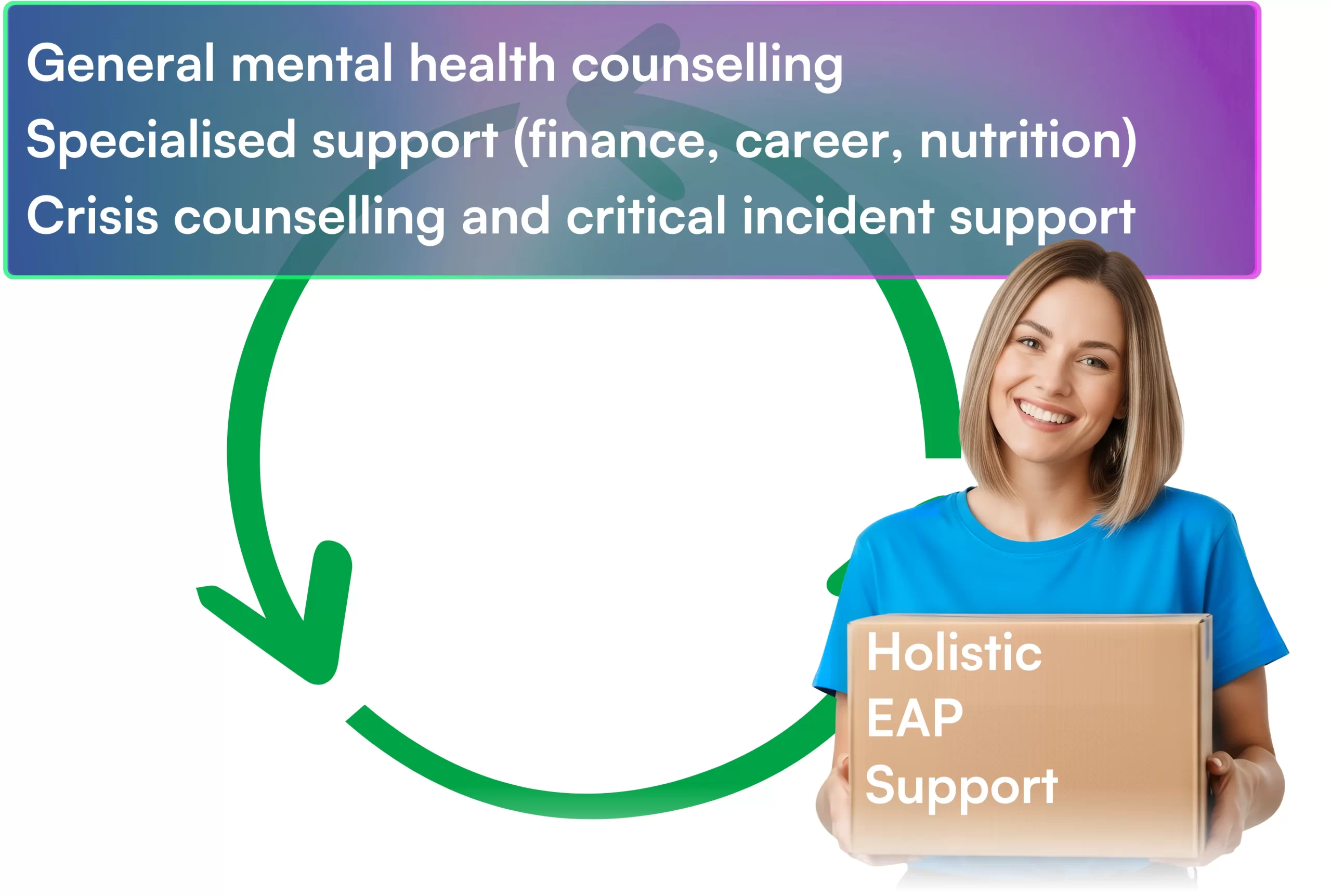

Counselling: Short-term support for mental health, stress, relationships, when people are in a mental health crisis, and workplace challenges.

Holistic wellbeing care: Financial coaching, career development, nutrition support, and more.
24/7 helplines: On-demand access to qualified professionals for urgent support

Manager support: Coaching for leaders on team wellbeing, communication, and conflict resolution

Critical incident: Support for employees when with traumatic planned and unplanned events occur, delivered through planned, crisis counselling, and onsite support.
→ Employees: Access support for personal or work-related concerns
→ Managers and leaders: Seek guidance on managing people, performance, and team dynamics
Who uses an EAP program
EAP programs are designed for organisation-wide use, supporting employees, leaders, and families. In addition, they support both proactive wellbeing and early intervention. Here are the different teams and employees who utilise EAP support
- Employees
- Leaders
- C-suite
- HR teams
- Immediate family members
- Teams and workplaces impacted by a critical incident
→ HR teams: Navigate complex or sensitive workplace situations
→ Family members: Often included to support issues impacting employee wellbeing
Core services every EAP provider should offer
Unfortunately, not all EAP providers are created equal. The right EAP services should offer support that scales with your business and understands the unique needs of your employees. They should offer more than just counselling; they should have technology enablement, a wide range of resources, and quality support that an employee can access however they chose, 24/7, from wherever they are. Equally, your EAP should include 24/7 crisis support for critical incident and urgent care for mental health challenges.
Here are some of the key aspects that employee assistance services should offer:


24/7 access (phone, digital, live chat)

Human support (face-to-face coverage and virtual counselling capabilities)

Employee assistance counselling (evidence-based and solution-focused)

Specialist support streams (financial, legal, family, crisis)

Manager and HR support tools

Digital tools (apps, portals, resources)

Workforce insights and reporting

Organisational services
What should you look for in an EAP provider?
Once you’ve shortlisted EAP providers, use this checklist to validate whether their services meet your organisation’s needs. The right provider demonstrates fast access, clinical quality, and measurable outcomes. The best EAP providers combine human support with digital tools to ensure employees can access help anytime, anywhere.
Key factors to validate when comparing EAP providers include:
➡ 24/7 access with fast response times
➡ Qualified clinicians with proven expertise
➡ Flexible delivery (face-to-face and virtual)
➡ Clear reporting with measurable outcomes
➡ Critical incident support
➡ Crisis counselling capability
Choosing an EAP provider with the below capabilities ensures your organisation delivers meaningful, accessible support that improves employee wellbeing, engagement, and performance. To help evaluate your options, here’s how EAP providers typically compare across key areas:
How to Choose the Right Employee Assistance Program for Your Organisation
Not all EAP providers are able to cater to all business types. As such, due-diligence and researching what each program offers is paramount. First and foremost, check if the EAP you’re considering is EAPAA accredited (the EAP central body, of which Converge is a part of). To choose the right Employee Assistance Program (EAP), focus on these 5 key factors:
- Access (24/7, digital and face-to-face support)
- Clinical quality (qualified, experienced professionals)
- Service scope (counselling, coaching, specialist support)
- Technology (apps, portals, booking systems)
- Reporting (measurable outcomes and insights)
Choosing an EAP based on these factors ensures your organisation selects a provider that delivers accessible, high-quality support with measurable outcomes.

How to assess the right EAP for your company
Here is a step-by-step process for evaluating an EAP program, and whether it matches your organisational needs:
Assess your workforce size and needs via HR data and surveys
Compare EAP providers and service scope
Evaluate access (24/7, digital vs face-to-face)
Review clinician quality and experience
Check reporting and measurable outcomes
Assess digital tools and accessibility (apps, portals, live chat, online booking)
Balance face-to-face and virtual support options (in-person, telehealth, phone and video counselling)
By assessing the capabilities of an EAP provider, you’re able to understand whether that EAP will be able to align with your culture, scale with your company, and underscore your long-term wellbeing strategy.
Key Questions to Ask EAP Providers Before You Commit
When you have a few EAP providers on your radar, you’ve reached out, and you’re ready to begin discussions, you need to question their capabilities. No question is off the table. After all, you need to know how the EAP will support your organisation on a medium to long-term basis. Equally, you need to know if the EAP will add benefit and advance your wellbeing strategy.
Here are some questions to keep in mind when discussing options with an EAP program:
- What types of employee assistance counselling do you offer?
- How quickly can employees access support?
- Do you provide digital tools or an EAP assist platform?
- How do you measure utilisation and outcomes?
- Can your EAP program scale with organisational growth?
- Does your EAP adhere to strict clinical governance and quality?
- Do they have a significant clinical network (for example, Converge has over 2,000 qualified and experienced clinicians)?
- Does your EAP have a partnership model where you have a key contact available to support you, your employees, and organisation?
Benefits of Choosing the Right EAP Program for Your Workplace
The key benefits of an EAP program include improvements in workplace wellbeing, culture, morale, productivity, and engagement. In addition, another tell-tale sign is an evident decrease in absenteeism, presenteeism, and mental health-related absences from work. This is where your EAP has made considerable organisational impact.
To recap, here are the main outcomes and EAP should deliver:
- A measurable increase in employee wellbeing and mental health outcomes
- Uplift in staff engagement and productivity
- Reduced absenteeism and presenteeism
- Stronger workplace relationships
- Organisational resilience and retention
What are the best EAP providers?
The best EAP providers are those that consistently deliver accessible, high-quality support and measurable outcomes for organisations and their employees. Rather than focusing on a single feature, leading providers demonstrate strength across clinical expertise, service delivery, and ongoing impact.
High-performing EAP providers typically:
- Deliver consistent, reliable support across multiple access channels
- Maintain strong clinical governance and professional standards
- Support a wide range of employee needs beyond counselling alone
- Provide scalable solutions that adapt to organisational growth
- Demonstrate clear impact through measurable wellbeing and performance outcomes
Ultimately, the best EAP provider is one that aligns with your organisation’s goals, workforce needs, and long-term wellbeing strategy.
How Converge compares to your EAP criteria
We’ve covered a lot in this article. We’ve highlighted the importance of assessing an EAP and how to evaluate an employee assistance program. Much of what we covered will be what you need from an employee counselling service. However, how does Converge compare to other EAP providers? Here is where we excel:
- We offer tailored counselling that transcends just basic wellbeing support. Our team are versed in mental health and wellbeing counselling, financial coaching, career development, nutrition support, legal assistance, and more.
- We have worked with organisations of all sizes, from small to large enterprises across many industries. That means we’re best placed to meet the unique challenges of your workforce and offer support that’s practical, safe and implementable from day one.
- All our counsellors, psychologists, dieticians, coaches, social workers, occupational therapists, lawyers (so on and so forth) have extensive experience, are registered with their relevant body, and tertiary qualified.
- We offer comprehensive reporting so you’re able to identify the wellbeing trends and challenges your workforce is facing and take steps to remedy workplace issues.
- Our support covers 95% of Australia (including metro, regional, and rural areas) and we can support your 100% of workforce virtually through telehealth counselling.
- We have the digital technology innovations to not only provide immediate access, but also crucial resources and tools to make wellbeing a priority and easier to manage.
- We operate 24/7/365, so if your employee needs us, they will always be able to receive the care they need from wherever they are, whenever they need us.
- We never take a one-size-fits-all approach. Our care is uniquely developed for the individual, meaning their support plan and sessions address what’s impacting them directly and indirectly, with actionable strategies developed for them.

Choosing the right EAP program: Answers to your frequently asked questions
What is an Employee Assistance Program (EAP)?
An Employee Assistance Program (EAP) is an employer-funded service that provides confidential counselling and wellbeing support to employees for personal and work-related challenges, helping improve mental health, productivity, and workplace culture.
How does an EAP work?
Employees access EAP services through phone, online portals, apps, or live chat, often with 24/7 availability. They are matched with qualified professionals and can attend sessions virtually or face-to-face, while all interactions remain confidential.
What services are included in an EAP?
EAP services typically include counselling, 24/7 helplines, manager support, crisis support, and holistic wellbeing services such as financial coaching, career guidance, legal support, and mental health support.
Who can use an Employee Assistance Program?
Employee Assistance Programs are available to employees, managers, HR teams, and often immediate family members, supporting both personal wellbeing and workplace-related challenges.
What should you look for in EAP providers?
The best EAP providers offer 24/7 access, qualified clinicians, strong clinical governance, digital wellbeing tools, face-to-face and virtual support, measurable reporting, and scalable services that align with your organisation’s needs.
Why is choosing the right EAP important?
Choosing the right EAP helps ensure employees receive timely, effective support, leading to improved wellbeing, higher engagement, reduced absenteeism, stronger workplace culture, and better organisational performance.
How do you choose the right Employee Assistance Program?
To choose the right EAP, assess your workforce needs, compare providers, evaluate access options, review clinician quality, and ensure reporting, digital accessibility, and measurable wellbeing outcomes are included.
What are the benefits of an EAP for organisations?
EAPs can deliver measurable return on investment through improved employee wellbeing, increased productivity, reduced turnover, lower absenteeism and presenteeism, and stronger workplace relationships and performance.