
EAP costs and ROI vary depending on workforce size, counselling delivery methods, reporting requirements, and wellbeing support inclusions. A well-designed Employee Assistance Program can improve productivity, reduce absenteeism, lower turnover, and generate measurable return on investment through earlier mental health intervention and workforce support. In this guide, we’ll explore the benefits of EAP, why organisations must invest in an EAP program, and the return on investment for EAP counselling.
Key Takeaways: Exploring the ROI of EAP
Reduced absenteeism and presenteeism through EAP counselling.
How EAP programs improve productivity and retention.
How to calculate EAP return on investment.
What influences EAP pricing and costs.
What are employee assistance programs (EAP)?
An Employee Assistance Program (EAP) is an employer-funded wellbeing service that gives employees access to confidential counselling, mental health support, wellbeing resources, and workplace guidance to help manage personal and professional challenges. EAP services are designed to improve employee wellbeing, reduce psychosocial risk, and support healthier, more productive workplaces.
Modern EAP programs typically include:
- Confidential EAP counselling for stress, anxiety, burnout, relationships, and workplace challenges
- 24/7 support access through phone, virtual appointments, apps, and online booking
- Manager support and leadership coaching
- Critical incident and crisis counselling services
- Wellbeing resources, webinars, articles, and proactive mental health tools
- Support for employees and, in many cases, their immediate family members
- Outcome reporting so you can see wellbeing trends and the effectiveness of your EAP program
- Organisational services such as training and development to strategically underpin workplace culture – more than just counselling.
EAP services help organisations reduce absenteeism, improve productivity, strengthen workplace culture, and support employee engagement through earlier intervention and accessible wellbeing support. As workplaces continue to evolve, EAP programs now combine human clinical expertise with digital wellbeing tools to make support more accessible than ever.
Understanding EAP costs, pricing, and what affects EAP ROI
EAP costs depend mostly on your organisation size, the support your employees need, and the benefits you are trying to secure for your people. Pricing for EAP can differ per provider. For example, some EAP providers offer a package system where you pay for what you use, whereas others offer a pay per employee per annum (PEPA) model. Here are the pros and cons of PEPA vs pay for what you use:
✔ More cost-efficient for low utilisation organisations
✔ Easier for SMEs to access EAP support
✔ Flexible and scalable as workforce changes
✔ Avoids paying for unused sessions
✔ Can encourage staged wellbeing investment
✘ Harder to forecast exact annual spend
✘ High utilisation periods can increase invoices unexpectedly
✘ Some providers may charge additional admin or crisis fees
✘ Budgeting can feel less predictable for finance teams
✔ Simpler procurement and finance approvals
✔ Unlimited or broader access models may improve utilisation confidence
✔ Encourages proactive promotion of the EAP
✔ Easier to package with enterprise wellbeing services
✘ Can become expensive for low-utilisation workplaces
✘ Less flexible during workforce reductions or restructuring
✘ Some providers cap sessions or apply fair-use conditions despite PEPA pricing
✘ ROI can appear lower if engagement is poor
While there are different ways to pay for your EAP, there can be a number of factors that increase or decrease your EAP costs:

Training and development initiatives often come at an additional cost.

Further proactive wellbeing management programs (webinars, assessments, and more).

Additional EAP counselling sessions outside your session allocation can come at an additional cost.

Bespoke offerings and psychosocial risk assessments to evaluate your workplace wellbeing risks are offered at an additional cost.

Trauma response programs including crisis counselling and onsite support.

Team size (100 employees will come at a different price compared to 10,000 employees).

Levels of reporting can influence your EAP pricing – for example, comprehensive reporting will cost more compared to basic reporting.

Face-to-face versus virtual EAP counselling can increase or decrease your cost depending on your package.
The additional return on investment of holistic workplace EAP services
Holistic EAP services improve return on investment by addressing employee wellbeing proactively through counselling, leadership support, crisis response, and preventative mental health initiatives.
While these points may seem like cost inflators, in fact, they can lead to greater ROI as employees are able to overcome their wellbeing challenges more effectively. This can lead to significant benefits for your organisation and workforce:
- Reduced absenteeism and presenteeism.
- Higher productivity.
- Higher profitability due to increased engagement and productivity.
- Increased employee engagement.
- Stronger workplace culture.
- Employees feeling valued and recognised.
- Enhanced employee focus.
- Ability to prevent personal issues from impacting their work.
- Additional wellbeing and workforce performance benefits.
- Reduced psychosocial risks that impact employee wellbeing.
Quick Summary
EAP Costs & ROI
EAP pricing and return on investment can vary depending on workforce size, utilisation, delivery model, and the level of support included. The overall ROI of an EAP depends on factors such as accessibility, employee engagement, clinician quality, and the provider’s ability to support both reactive and preventative wellbeing strategies. Here are the key things organisations should know:
01
EAP pricing varies based on workforce size, support scope, and counselling delivery methods
02
Most EAPs use either PEPA pricing or pay-for-use models
03
Effective EAP programs can reduce absenteeism, turnover, and psychosocial risk
04
Studies show workplace mental health initiatives can deliver positive ROI
05
Modern EAPs combine counselling, digital wellbeing tools, reporting, and preventative support
How much does an EAP cost?
To recap: EAP costs can vary depending on workforce size, counselling inclusions, reporting requirements, and delivery methods. More comprehensive Employee Assistance Programs that may cost more than basic virtual-only EAP solutions include:
- Critical incident support
- Manager coaching
- Psychosocial risk consulting
- And face-to-face counselling

The ROI of EAP
The ROI of EAP is typically measured through reduced absenteeism, improved productivity, lower turnover, and reduced psychosocial risk. The goal of EAP is to help your people feel their best and overcome everyday personal and professional challenges and hurdles.
Overcoming such challenges can then translate to their work and their ability to perform at their highest productivity level. Thus, the best way you can calculate the ROI of EAP mostly encompasses the productivity, engagement, and focus of your workforce after embedding an EAP program:
Reduced time spent away from work due to mental health: Have you seen a decrease in the amount of mental health days, sick days, complaints of burnout, or employees appearing fatigued? If so, and they have used your EAP program, your investment is working. Additionally, EAP can help reduce the amount of workers compensation mental health claims through early intervention, confidential care, and proactive risk management.

General mood and morale uplift: Are employees and leaders more energised, and has morale improved? If so, EAP may have played a part to help reduce workplace conflict, low morale, and the way managers lead teams.

Productivity, engagement, and innovation: Your EAP may have helped employees become more productive, engaged in their work and collaborative, and given them wellbeing strategies to diminish mental health-related challenges. The result can be more innovative ideas and solutions that may accelerate organisational performance and innovation.

Supporting leaders and managers: EAP offers essential guidance and support for leaders and managers, helping them navigate challenging workplace issues, such as performance and wellbeing conversations and conflict. People management can be complex especially when leaders are faced with poor wellbeing and crisis. That’s where EAP can play a significant role in helping managers thrive.

How to measure EAP return on investment
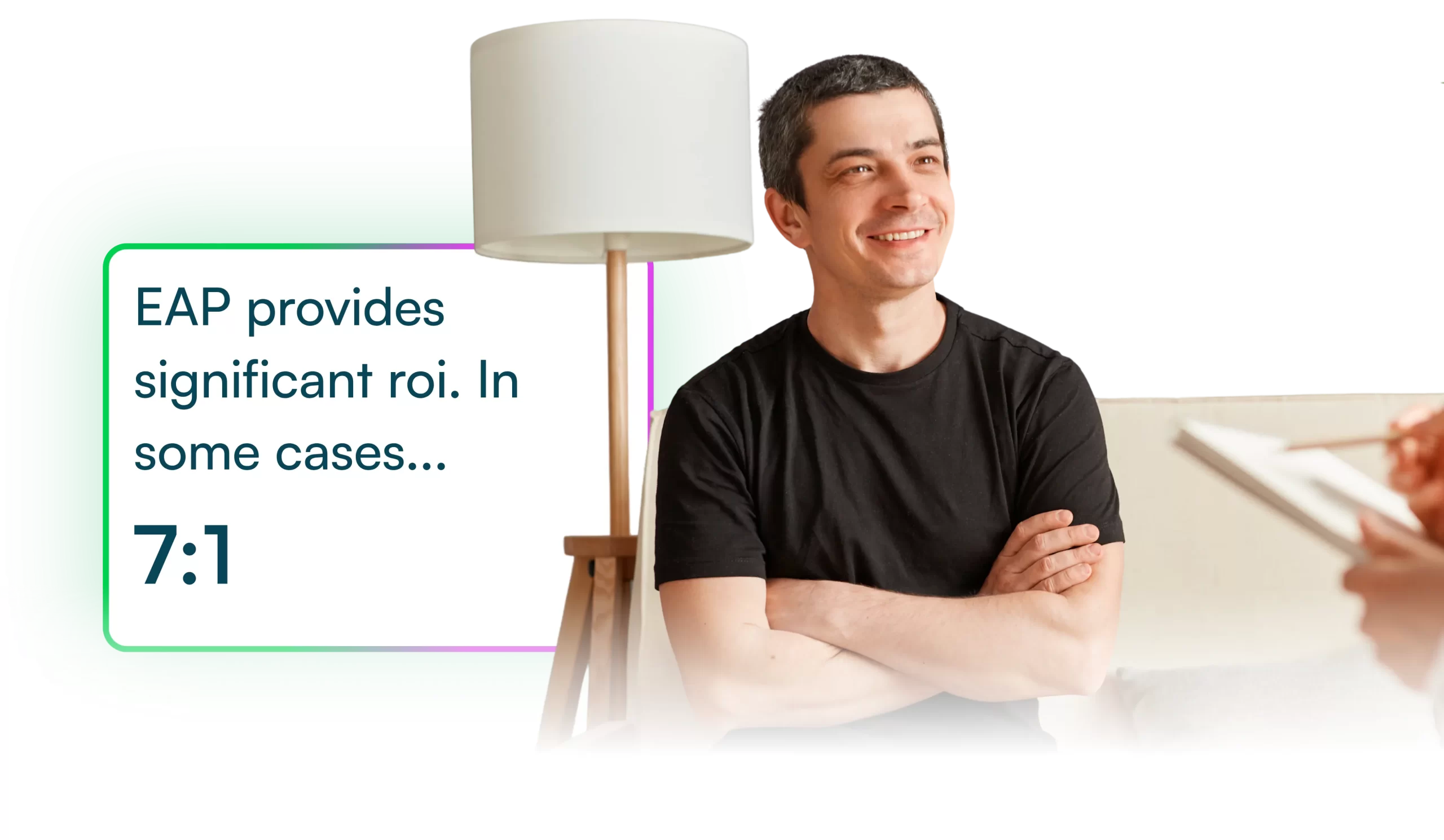
The return on investment for EAP is calculated by identifying the net benefits (higher productivity, reduced absenteeism, and less turnover), calculating the dollar value of those benefits, and dividing them by the cost of your EAP program. Once you know your total, multiply that number by 100 and you have your EAP ROI. For example, Converge often sees a 7:1 return on investment, with a case study developed in partnership with AGL showcasing that our support generated a return on investment in excess of 300%. For broader EAP ROI, PwC outlines that:
“
“Mental health conditions present substantial costs to organisations. However, through the successful implementation of an effective action to create a mentally healthy workplace, organisations, on average, can expect a positive return on investment (ROI) of 2.3. That is, for every dollar spent on successfully implementing an appropriate action, there is on average $2.30 in benefits to be gained by the organisation.”
Key tip from our Converge Chief Clinical Officer, Cate Page:
“When exploring the ROI of EAP, you need to understand the value your EAP program has provided. Ultimately, we’re here to help your employees feel mentally fit and resilient, both inside and outside of work.
Our benefits are for both employees and employers, so if you see a noticeable uptick in wellbeing, productivity, and performance, your EAP program is working and delivering its benefits.”

Key EAP ROI metrics and steps to calculate your return on investment
There are key metrics you need to evaluate to understand the ROI of your EAP program, including reductions in absenteeism, improvements in presenteeism and work-life balance while maintaining positive organisational output. According to a PwC study, EAP holds an average ROI of $2.30 per dollar spent, showcasing significant value.
Equally, you need to understand your savings in turnover costs – are your employees remaining in their positions longer and is job satisfaction high? Finally, equate your claims management costs, such as mental health-related workers’ compensation claims, prior to onboarding your EAP and subsequently, have claims dropped since.
Here is a step-by-step guide on calculating the ROI of your EAP and the parameters you need to consider:
Evaluate key metrics
Evaluate what your turnover costs, absenteeism and presenteeism financial impacts, and the cost of mental health claims, 6-12 months prior to onboarding your employee assistance provider, and collate the data on the above based on the 6-12 months post-onboarding your EAP.
Calculate EAP costs
Calculate the cost of your EAP – regardless of whether you pay monthly or annually. Then work out the cost of promotion of your EAP program – including resources such as printing and staff time to promote your EAP.
EAP ROI
Measure costs, compare workforce outcomes, and evaluate the financial and cultural return generated by your wellbeing strategy.
Measure ROI outcomes
Compare changes in compensation claims, retention, productivity, engagement, wellbeing, absenteeism, and turnover against your total EAP investment to understand your ROI.
Tips for choosing the right EAP for your organisation
Choosing the right EAP provider for your organisation depends on what you require and how you would like your new EAP to integrate into your wellbeing strategy. For example, costs and service offerings may differ if you only need basic support options for your 20 employees in a singular metro city. Conversely, if you need complex wellbeing support for your multinational, 10,000-strong workforce across various metro, regional, and rural areas, you will need a more comprehensive EAP.
Why choose Converge as your EAP
At Converge, for example, we offer EAP counselling support options that scale with organisations – from small-to-medium-sized businesses who have 50 to 1,000 employees, to complex organisations with over 100,000 employees. To achieve our scalability, we offer a range of self-service and tailored, partnership-led solutions for businesses of all sizes. For example, our solutions include:
- 2,000+ qualified, certified, and experienced mental health clinicians.
- Digital tools to increase access to wellbeing support, resources, and tools (including our Converge App, Employee Wellbeing Portal, and Service Hub).
- Comprehensive data and reporting that demonstrates our value and highlights wellbeing trends, including citations of 100% impact after two sessions and 87% employee satisfaction scores.
- Global support capability, as well as metro, regional, and rural counselling access across Australia (95% face-to-face and 100% virtual), meaning if employees are in hard-to-reach places, we will be there.
- 9 EAP support streams targeting holistic employee wellbeing (nutrition support, general counselling, financial and career coaching, neurodiversity support, and more), as well as 7 specialist helplines, including LGBTQIA+, First Nations, and domestic and family violence, where clinicians have either lived experience and/or specialised training.
Converge EAP delivery in numbers
We continue to innovate and evolve our EAP solutions with all the above and more, offering significant ROI to our partner organisations. Many of our key stats demonstrate our value to employees and employers alike, for example, in FY25 we delivered:
- 326,000+ hours of support to employees.
- 43,800 hours of support during critical incidents.
- Supported clients and employees at over 4,100 high-impact events.
- Supported over 2.6 million employees.
What are the best EAP providers?
The best EAP providers are those that consistently deliver accessible, high-quality support and measurable outcomes for organisations and their employees. Rather than focusing on a single feature, leading providers demonstrate strength across clinical expertise, service delivery, and ongoing impact.
High-performing EAP providers typically:
- Deliver consistent, reliable support across multiple access channels
- Maintain strong clinical governance and professional standards
- Support a wide range of employee needs beyond counselling alone
- Provide scalable solutions that adapt to organisational growth
- Demonstrate clear impact through measurable wellbeing and performance outcomes
Ultimately, the best EAP provider is one that aligns with your organisation’s goals, workforce needs, and long-term wellbeing strategy.
How Converge compares to other EAP providers
Not all EAP providers deliver the same level of support, accessibility, or wellbeing outcomes. While many providers offer standard counselling services, the best Employee Assistance Program (EAP) providers combine qualified clinical expertise, 24/7 access, digital wellbeing tools, measurable reporting, and flexible support models tailored to modern workplaces. Here is how Converge compares to other EAP providers:
✔ Supports 100% of Australians (virtually)
Is investing in an EAP worth it?

Investing in an Employee Assistance Program delivers measurable business and wellbeing benefits through reduced absenteeism, improved productivity, stronger employee retention, and better psychosocial risk management. The most effective EAP providers combine qualified clinical support, digital wellbeing tools, proactive mental health resources, and measurable reporting to maximise workforce outcomes and return on investment.
Why not give Converge a try? We can demonstrate the value we bring to your employees’ wellbeing and the ROI for your business. With more than 2,000 dedicated clinicians, we provide meaningful support for employees alongside a proven 7:1 return on investment, delivering measurable impact across workforce wellbeing and organisational performance.
Enquire now!

Frequently asked questions about EAP ROI
What is the typical EAP cost for companies of different sizes?
EAP costs vary depending on organisation size, service inclusions, counselling delivery methods, and reporting requirements. Most Employee Assistance Programs (EAP) are priced either per employee or through a monthly management fee model.
Smaller businesses may choose a simpler EAP package focused on virtual counselling and basic reporting, while larger organisations often require broader services such as critical incident response, manager support, psychosocial risk consulting, face-to-face counselling, and advanced reporting dashboards. Organisations with regional, national, or global workforces may also require more scalable support models, which can influence EAP costs further.
How can businesses calculate the EAP return on investment?
Businesses can calculate EAP return on investment (ROI) by comparing the financial benefits gained from improved employee wellbeing against the total cost of their EAP program. Key ROI indicators include reduced absenteeism, lower presenteeism, reduced turnover, fewer psychological injury claims, and improved productivity.
A simple EAP ROI equation is:
(Financial benefits gained from EAP – EAP costs) ÷ EAP costs × 100 = ROI percentage
To calculate ROI effectively, organisations should:
- Measure absenteeism and turnover before and after implementing EAP
- Assess productivity and engagement improvements
- Track reductions in workers’ compensation or mental health claims
- Include EAP program costs, promotion costs, and implementation expenses
- Review employee wellbeing and satisfaction outcomes
The article notes that Converge commonly sees a 7:1 return on investment, while broader workplace mental health studies from PwC found organisations can achieve an average ROI of 2.3:1 through effective mental health initiatives.
What factors influence EAP pricing?
Several factors influence EAP pricing, including workforce size, service complexity, counselling delivery options, and wellbeing program inclusions. Organisations requiring broader wellbeing support or tailored services will generally invest more than businesses seeking basic counselling access only.
Common factors that affect EAP costs include:
- Number of employees covered
- Face-to-face versus virtual counselling access
- Critical incident and crisis response services
- Manager support and leadership coaching
- Psychosocial risk assessments and consulting
- Reporting depth and analytics requirements
- Additional counselling sessions beyond allocation
- Digital wellbeing tools, apps, and online portals
- Webinars, wellbeing training, and preventative initiatives
- Regional, rural, national, or global workforce coverage
While more comprehensive EAP services may increase pricing, they can also improve employee engagement, accessibility, and overall return on investment.
Are EAP programs worth the investment for small businesses?
Yes. EAP programs can deliver significant value for small businesses by helping employees access confidential mental health and wellbeing support before challenges escalate into larger workplace issues. Small businesses often benefit from reduced absenteeism, improved productivity, stronger workplace culture, and better employee retention when EAP services are embedded effectively.
Modern EAP providers also offer scalable solutions designed specifically for small and medium-sized businesses, allowing organisations to access wellbeing support without needing enterprise-level budgets. Flexible virtual counselling, digital wellbeing tools, and manager support services can help smaller organisations improve wellbeing outcomes while maintaining cost efficiency.
How can organisations reduce the cost of EAP programs without affecting quality?
Organisations can reduce EAP costs without lowering quality by choosing scalable, flexible EAP solutions that align with workforce needs rather than overinvesting in unnecessary services. The key is balancing accessibility, utilisation, and clinical quality with the organisation’s wellbeing goals.
Strategies to reduce EAP costs while maintaining quality include:
- Using blended virtual and face-to-face counselling models
- Selecting scalable packages based on workforce size
- Improving EAP promotion to increase utilisation and ROI
- Leveraging digital wellbeing tools and self-service resources
- Using preventative wellbeing initiatives to reduce crisis-related costs
- Reviewing reporting requirements and service inclusions regularly
- Partnering with an EAP provider that offers integrated services under one solution
Higher utilisation and earlier intervention often lead to stronger wellbeing outcomes and lower long-term organisational costs, making strategic EAP design critical for maximising ROI.