
Key Takeaways: The power of EAP providers who use wellbeing technology and human support
Why human support remains essential in EAP counselling and workplace psychology.
How digital wellbeing and human care work together to strengthen employee wellbeing.
What to look for in EAP services and corporate wellness programs.
Why workplace wellbeing needs both digital tools and human support
Technology and human support bring together accessibility, flexibility and human expertise in the support experience. The following explains how wellbeing technology can enhance employee wellbeing:
- Technology provides staff with improved access to an experienced psychologist or counsellor.
- Wellbeing technology offers a convenient and flexible format for employees to reach out for support in a way that is most comfortable for them.
- Digital wellbeing tools also offer proactive resources for preventative mental health exercises, helping staff potentially avoid escalation of wellbeing concerns.
Human support goes a step further than technology. Through the power of connection, employees can access:
- An empathetic, evidence-based and therapeutically trained professional
- Safe and practical clinical judgement
- Tailored care based on the individual’s needs
Ultimately, technology and human support are not mutually exclusive. On the contrary, when considering your wellbeing strategy, you should be searching for a provider who holds a network of experienced clinicians, with wellbeing support complemented by technology.
What wellbeing technology can do well for employee wellbeing
Wellbeing technology unlocks a range of accessibility, flexibility and convenience enhancements that were not traditionally available. With technology becoming more prevalent, and digital literacy becoming more normalised, wellbeing technology should be genuinely considered as part of any wellbeing strategy.
Wellbeing technology can provide:
- 24/7 access
- Self-guided support
- Habit-building tools
- On-demand resources
- Proactive engagement
- Lower barrier to entry for support
According to ABS statistics, digital inclusion has grown to encompass 73.2% of Australians. That means that more and more people have access to technology and, more importantly, they know how to use it. As a result, there is less resistance to using technology, leading to staff members absorbing the benefits to digital wellbeing apps and portals.
If we take Converge as an example, we had over:
- 65,000 active app users in FY25.
- 50,000 new app registrations in FY25.
- Digital wellbeing apps and portals played a pivotal role in facilitating over 300,000+ meaningful engagements with the employees we support.
- Our digital tools have strongly underpinned much of our 326,000+ clinical appointments booked in FY25.
Where human support is still essential in EAP counselling and workplace psychology
While technology is essential in the modern workplace, it cannot replace the expertise, emotional intelligence, and experience of the clinical team supporting your people via your EAP services. At Converge, our clinical network of over 2,000 clinical experts are the ones who deliver the care we provide to the 6.7 million employees we support from 1,700+ partner organisations. They are backed by our wellbeing technology, creating an ecosystem where care is readily available, fully accessible, and delivered by a human who can support your staff with their mental health.
Wellbeing technology and wellbeing apps should underpin support, but not facilitate the care itself. That care continues to be best delivered by an accountable and experienced professional who can provide objective support within an EAP counselling session. Digital technology can be informative but it lacks human emotions, risk accountability, nor the objective experience to handle trauma and grief.
Here is a list of where technology can fall short and human expertise can prevail.
- Supporting staff with complex mental health concerns
- Risk and crisis support
- Trauma, grief, conflict, burnout
- Nuanced care, clinical judgement, trust and therapeutic rapport
- Tailored support from workplace psychology professionals
Dangers of AI in delivering EAP support
Some may say that Artificial Intelligence has the power to provide workplace psychology support. However, AI can also sometimes pose a risk. According to Beyond Blue, AI should not act as a substitute for professional mental health care. AI can support access to information and self-guided tools, but it should not replace clinically accountable care, crisis support or personalised treatment delivered by a qualified professional. AI can also assist with wellbeing education, navigation and self-guided resources, but it should complement, not replace, qualified clinicians when employees need professional mental health support. AI limitations extend to its inability to diagnose, treat and understand your staff’s personal situation, whereas a qualified clinician can.
Ultimately, AI chatbots (generative AI) tend to agree with the user, can often provide wrong or incorrect information, and people can build a dangerous dependency on their chatbot, which Beyond Blue says can negatively impact their wellbeing . As such, support should always be delivered by a human. Human support delivers rational, expert guidance to your staff, and qualified clinicians can also diagnose and treat mental health conditions. This reflects the mistrust people often have in self-diagnosis, particularly when someone says they “Googled their illness”.
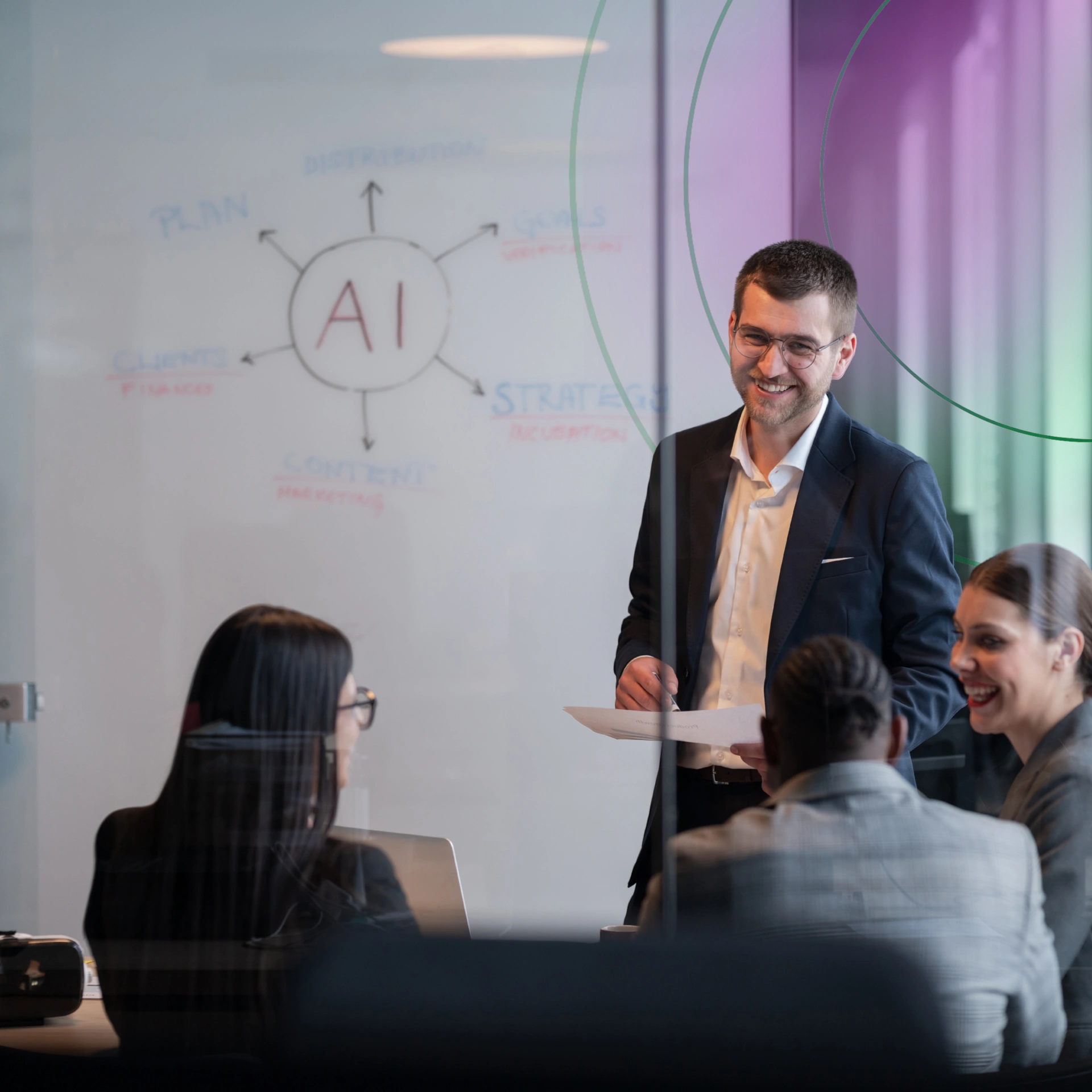
“51% of organizations using AI have seen at least one negative consequence”
Technology vs human support is the wrong question for EAP services
Organisations shouldn’t view workplace wellbeing as technology versus people. The strongest EAP services combine digital wellbeing technology with qualified human support, using each where it delivers the greatest value. Rather than thinking in terms of ‘technology or people’, organisations should embrace ‘technology and people’. Here’s how technology and human care work together:
Technology support
- Technology can help people reach support delivered by a human clinician.
- Technology removes barriers to human support, allowing employees to book appointments through an app or employee wellbeing portal.
- Individuals can access counselling from a human clinician in more convenient formats, including virtual telehealth appointments via secure video.
- Technology provides self-service wellbeing tools and resources that help people proactively manage their wellbeing and recognise when they may benefit from human support.
- Wellbeing apps integrated with smartphones and wearables can identify indicators such as poor sleep, which may be linked to mental health concerns, encouraging people to seek psychological support.
- Technology bridges the gap between awareness, promotion and reach by making Employee Assistance Program (EAP) information and wellbeing resources accessible quickly and seamlessly.

Human support
- Human clinicians bring rational thinking, professional judgement and emotional intelligence that technology cannot replicate.
- People can build genuine therapeutic relationships with clinicians, allowing psychological support to be tailored to their individual needs and circumstances.
- Qualified psychologists and counsellors have years of clinical training and experience, enabling them to provide more precise, evidence-based and objective care.
- Human support is accountable, ethical and professionally regulated, helping ensure safe, high-quality care throughout the support journey.
- When combined with wellbeing technology, human support also delivers measurable outcomes that can be tracked against personalised wellbeing goals.
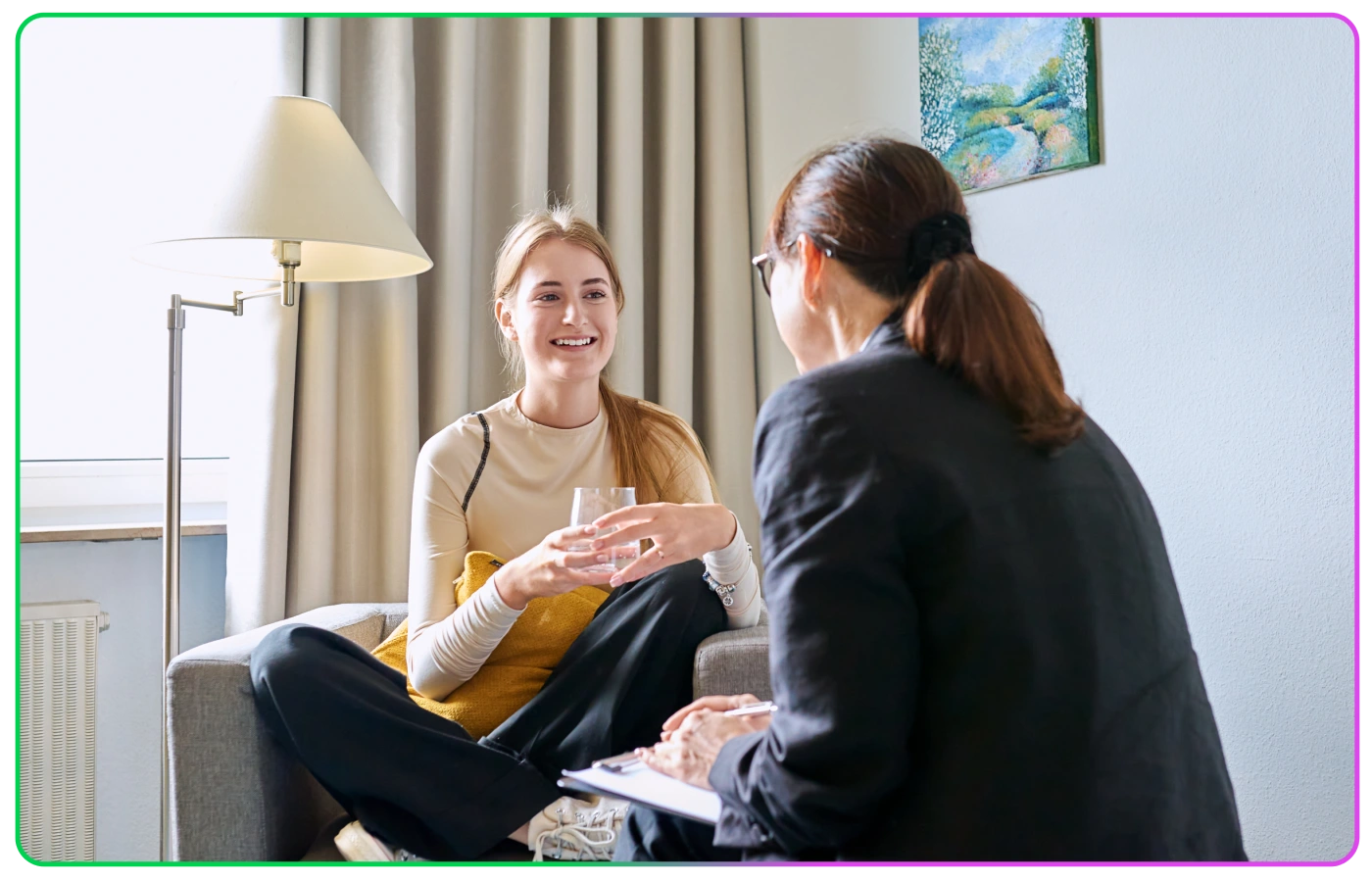

Both lists aren’t an argument for one modality over the other. Instead, they explain how technology can support individuals in seeking support, and how human care outweighs the current capabilities of digital wellbeing platforms in particular areas. At Converge, we follow the mantra of combining wellbeing technology with human EAP care. Each piece of content is developed by a clinical expert and the support we deliver is conducted by a human professional. Overall, the message is that our technology is an extension of our human expertise, not a replacement.
How digital wellbeing and EAP services work better together
What our equation below means is employees can self-serve where appropriate (through modalities such as podcasts and articles) and escalate to human support when they need it. That means human care remains available for complex and crisis-level issues, and for minor to moderate wellbeing concerns that individuals may want to get ahead of with the support of a human expert.
Similarly, technology can increase visibility and engagement with EAP support as it provides more comfortable booking and support methods. For example, some people may prefer to book online over calling and sharing their condition with a contact centre agent, and vice versa.
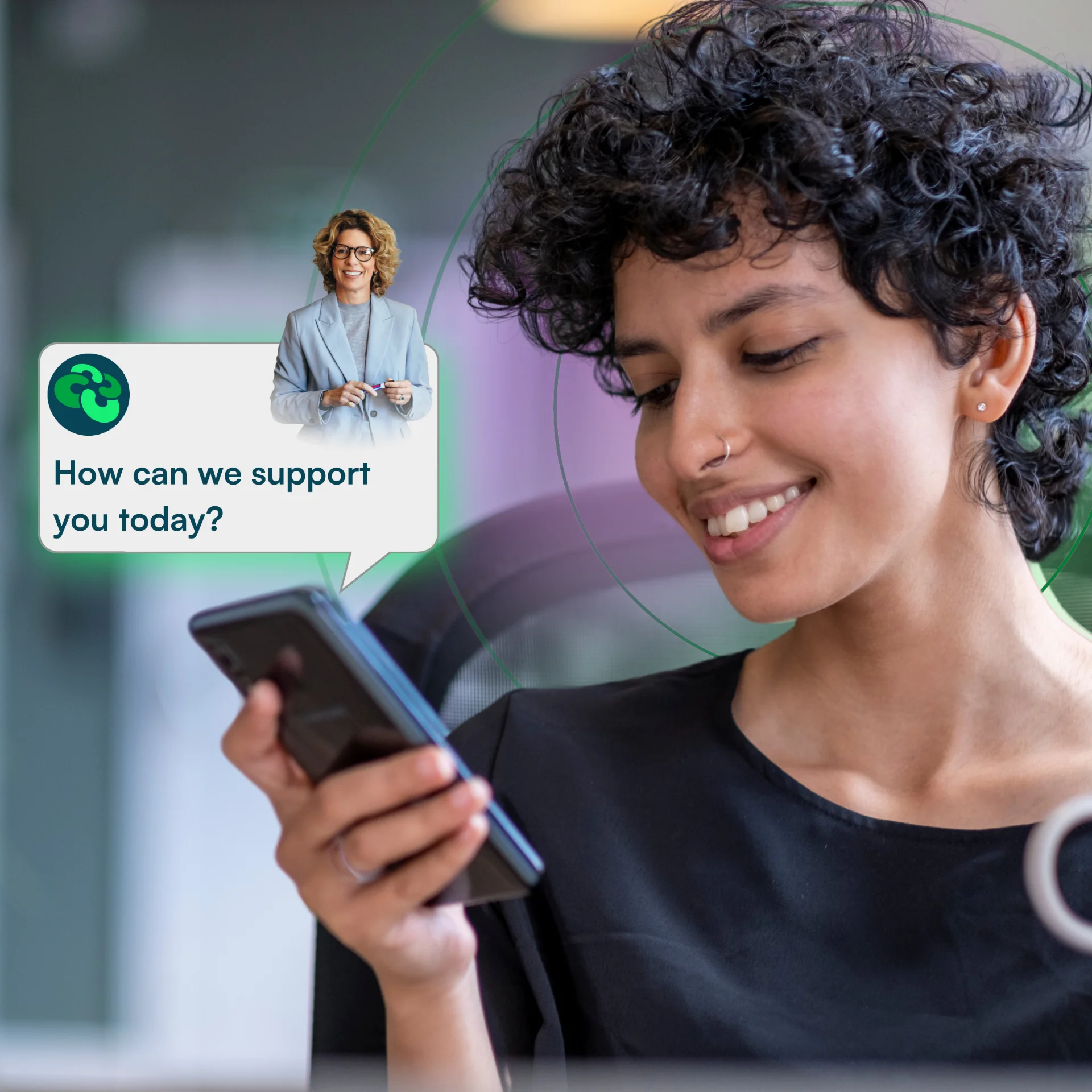

The equation for mental health support should be:
App or portal + digital or phone booking + human triage + counselling and resources = measurable, positive outcomes.
Digital Wellbeing Tools
How Converge combines wellbeing technology with human support
At Converge, we have three key wellbeing platforms:
For employees
The Converge App
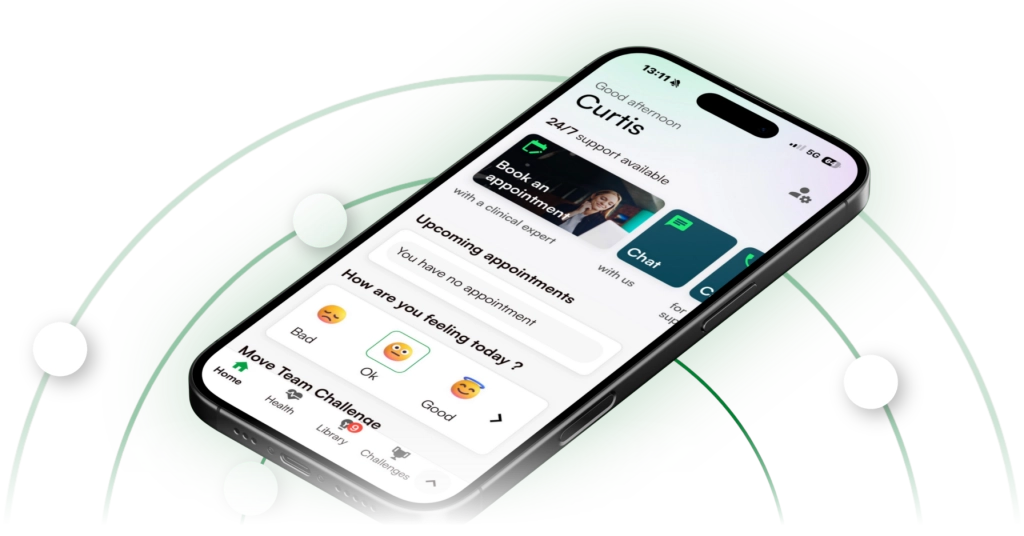
A one-stop-shop for mental health and wellbeing, offering tailored resources, engaging challenges with measurable outcomes, and booking methods to access human support.
For employees
Wellbeing Portal
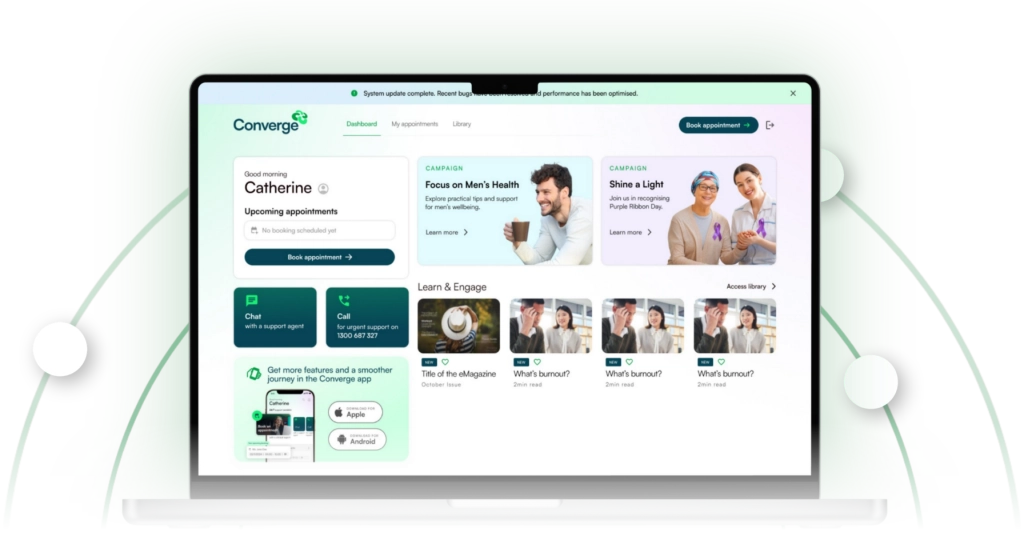
Like the Converge App, the Wellbeing Portal provides staff with tools and resources, along with online booking methods 24/7/365.
For HR & decision makers
Converge Service Hub
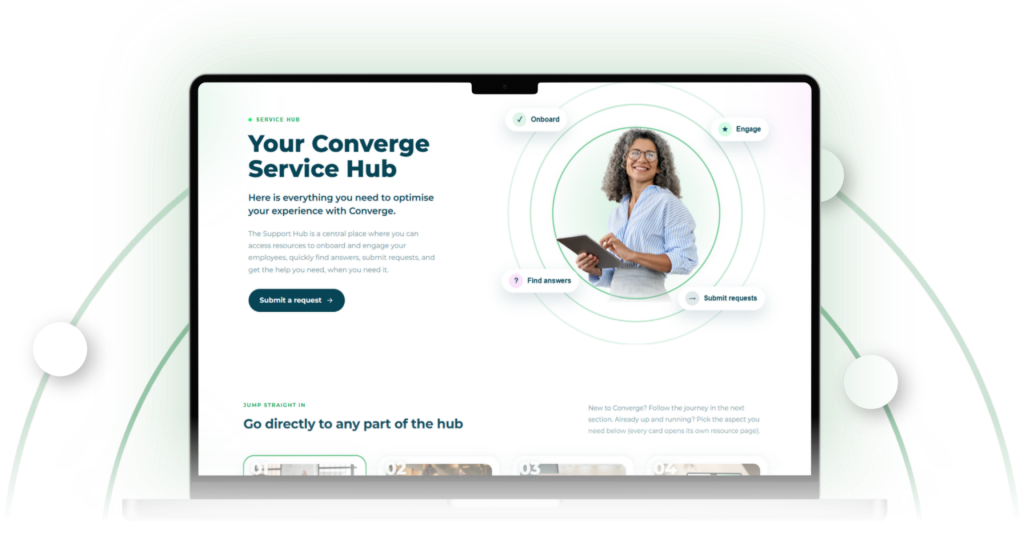
A self-service portal for leaders to use for promotion of EAP and human support. This platform provides the promotional resources they need, guides on how to promote EAP, as well as campaign tools to make support more visible, accessible and easier to promote.
All three platforms offer a cross-functional, technological method for employees to receive support from qualified professionals (through 24/7 booking methods) and proactive wellbeing resources. As we’ve said, our technology is an extension of our human capabilities. Through our technological enhancements, we’ve made connecting with a qualified professional easier, quicker, simpler, and more comfortable for employees.
What organisations should look for in workplace wellbeing and corporate wellness programs
When exploring employee assistance program (EAP) options, organisations should evaluate an EAP provider’s digital tools and human workplace wellbeing support. Corporate wellness programs should be easy to access, flexible in use, and convenient for the employee. As such, here is how you should approach the evaluation of an EAP:
Step 1: Their clinical network
Do they have qualified clinicians behind their services? At Converge, our clinical network comprises 2,000+ qualified, certified, trained, and experienced psychologists, coaches, occupational therapists, counsellors, dieticians, and social workers.
Step 2: Their digital wellbeing tools – are they useful
Question how useful and easy to navigate their digital wellbeing tools are. Assess how easily staff can download the app, access the portal, find relevant resources, and book appointments with clinical experts.
Step 3: Their reporting and engagement visibility
Does your EAP offer reporting on trends and the challenges impacting your workforce? How easy is it to access and interpret the data, and does it paint a comprehensive picture of mental health in your workplace?
Step 4: Does their support fit businesses of all sizes and go beyond counselling alone?
Can you identify whether their support resources are limited to smaller businesses, or whether they cater primarily to more complex organisations, which may mean their tools are harder for small businesses to navigate?
Key callout
At Converge, our systems offer something for everyone: those who love apps can download and use our app, those who prefer browser-based platforms, and human triage for employees who prefer to book appointments over the phone. Equally, we set leaders up for success from day 1 with our Service Hub, which is dedicated to ongoing engagement and simple onboarding.
We also tailor our capabilities to businesses of all sizes so that Australia’s largest and smallest companies can get the same expert support, reporting, and resources for their people. Finally, we go beyond counselling alone, offering a broad wellbeing ecosystem of proactive resources, crisis counselling, mental health support, specialised services, leadership development guidance, and more. Reach out to see how we can support your organisation today!
Looking for an EAP backed by human expertise & digital tools?
At Converge, we pride ourselves on our growing clinical network, training capabilities, and digital tools that have created a holistic care model that can support your staff at any point of their wellbeing journey. That’s why our mantra is: care, anytime, anywhere. Fill out the form below to get in touch. We’d love the opportunity to showcase our capabilities.
Frequently Asked Questions about wellbeing technology, human support and EAP services
Can wellbeing technology replace human support in EAP services?
No. Wellbeing technology can improve access, flexibility, digital booking and proactive support, but it should not replace qualified human support. In EAP services, human clinicians remain essential for empathy, clinical judgement, personalised care and support for complex issues such as trauma, grief, burnout and crisis.
Why is human support still important in workplace wellbeing?
Human support is important in workplace wellbeing because qualified clinicians can provide empathy, therapeutic rapport, accountability and tailored support that technology cannot deliver on its own. Human care is especially important when employees need EAP counselling for complex mental health concerns, conflict, trauma, grief or crisis.
How do digital wellbeing tools support employee wellbeing?
Digital wellbeing tools support employee wellbeing by making workplace wellbeing support easier to access and use. They can provide 24/7 booking pathways, self-guided resources, on-demand wellbeing content, habit-building tools and proactive support that help employees take early action and engage with EAP services more easily.
How do EAP services combine technology and human support?
The best EAP services combine technology and human support by using apps, portals and digital booking tools to improve access to care, while ensuring counselling and workplace psychology support are delivered by qualified clinicians. Technology removes barriers to support, while human expertise provides the tailored care and clinical judgement employees need.
What should organisations look for in an EAP provider?
Organisations should look for an EAP provider with qualified clinicians, useful digital wellbeing tools, simple booking and access pathways, strong reporting and engagement visibility, and support that fits organisations of different sizes. The best providers combine workplace wellbeing technology with accountable human support.
Are mental wellness apps enough to support employees at work?
Mental wellness apps can support employee wellbeing by improving access to resources, self-guided tools and early intervention support. However, they are not enough on their own. Employees also need access to qualified human support through EAP counselling and workplace psychology services when issues are complex, sensitive or high risk.