
Executive Summary
A safety net is no longer enough
For decades, EAPs were largely viewed as a safety net, a confidential service employees accessed when personal or workplace challenges became difficult to manage.
That model is changing. The future of EAP is not defined by how many people attend counselling; it is defined by how effectively organisations prevent harm, build capability and create environments where people can thrive.
This shift is being driven by changing workforce expectations, new psychosocial health and safety obligations, rapid advances in artificial intelligence (AI), and growing pressure on organisations to demonstrate measurable returns on wellbeing investments.
Drawing on emerging research and Converge’s experience supporting organisations across Australia and New Zealand, this paper explores five trends that are reshaping the future of EAP.
Index
WRITTEN BY
| Mary Talbot Executive Director of Digital |  |
With a background spanning digital transformation, product innovation, and marketing, Mary brings these worlds together to design experiences that make a genuine difference and build solutions that leave workplaces stronger, healthier and more connected.
| Jenny Filby General Manager of Analytics |  |
Jenny leads Converge’s data team, developing invaluable and comprehensive utilisation reports, highlighting key organisational areas and issue-based trends within our partner organisation. Each report is used to improve the wellbeing of the people we care for.
| Cate Page Clinical Review • Chief Clinical Officer |  |
Cate has over two decades of experience in EAP, consultancy, and training. A former manager of the Beyondblue National Workplace Program, Cate is a sought-after expert in mental health in the workplace.
Key takeaways: 2026 Trends in Workplace Mental Health
- Modern EAP is evolving beyond counselling into a proactive workplace wellbeing ecosystem focused on prevention, psychosocial risk management and measurable organisational outcomes.
- Managers, leadership capability and workplace culture are becoming critical drivers of employee wellbeing, engagement and psychological safety.
- Artificial intelligence and digital wellbeing technology will enhance human care, improve accessibility and support more personalised wellbeing experiences.
- Organisations that combine expert human support, technology, data and evidence-based wellbeing strategies will be best positioned to create healthier, safer and higher-performing workplaces.
Trend 1: EAPs are moving from support services to psychosocial risk partners
“As psychosocial health and safety regulation matures across Australian jurisdictions, expect regulators to move from guidance to enforcement — meaning organisations without documented psychosocial risk monitoring in place by 2027 face materially higher exposure to both compensation claims and regulatory action.”
4×
longer median time lost on mental-health workers’ comp claims than physical injuries, despite being 9% of claims (Safe Work Australia)
$1.30–$4.70
return for every dollar invested in evidence-based workplace mental health interventions (Deloitte)
Modern EAP services are evolving beyond traditional counselling to become strategic partners in psychosocial risk management, helping organisations identify workplace risks before they become employee mental health issues.
In modern workplaces, the biggest change facing Australian employers is the shift from responding to psychological injuries to preventing them.
The introduction of psychosocial health and safety regulations has fundamentally changed employer responsibilities. Organisations are now expected to identify, assess and control psychosocial hazards in the same way they manage physical safety risks. These hazards include excessive workloads, poor organisational change management, bullying, inadequate support, low role clarity and workplace conflict. (Safe Work Australia)
This regulatory shift is changing expectations of EAP providers. Rather than simply offering confidential counselling after problems arise, employers increasingly expect EAPs to provide workforce insights, identify emerging risks and recommend preventative actions.
The business case is compelling. Safe Work Australia reports that mental health conditions now account for 9% of all serious workers’ compensation claims, yet these claims involve more than four times the median time lost and more than three times the compensation costs compared with physical injuries. (Safe Work Australia)
Similarly, Deloitte estimates workplace mental ill-health costs Australian businesses billions annually and found that evidence-based workplace mental health interventions can return between $1.30 and $4.70 for every dollar invested. (Deloitte)
This requires a different relationship between organisations and EAP providers. The traditional procurement model, selecting an EAP based primarily on cost, access and utilisation, is being replaced by a partnership approach focused on shared accountability for workforce wellbeing outcomes.
It’s worth noting that data-driven psychosocial risk reporting is only as useful as the action it prompts. Benchmarking and dashboards can create a false sense of progress if organisations treat reporting as the deliverable rather than the starting point for intervention. Employers should also be transparent with employees about how aggregated wellbeing data is collected, de-identified and used. Trust in the reporting process is a precondition for the honest self-reporting the model depends on.
Making the invisible visible with data-driven psychosocial risk insights
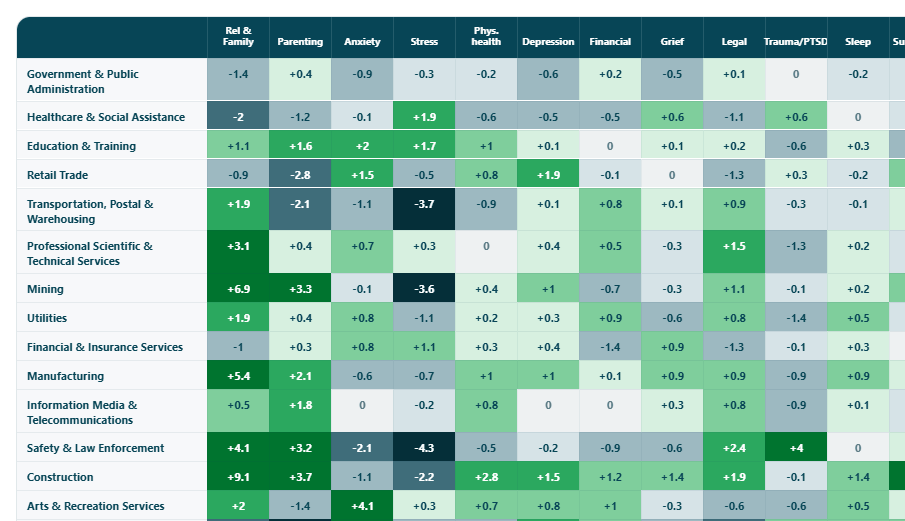
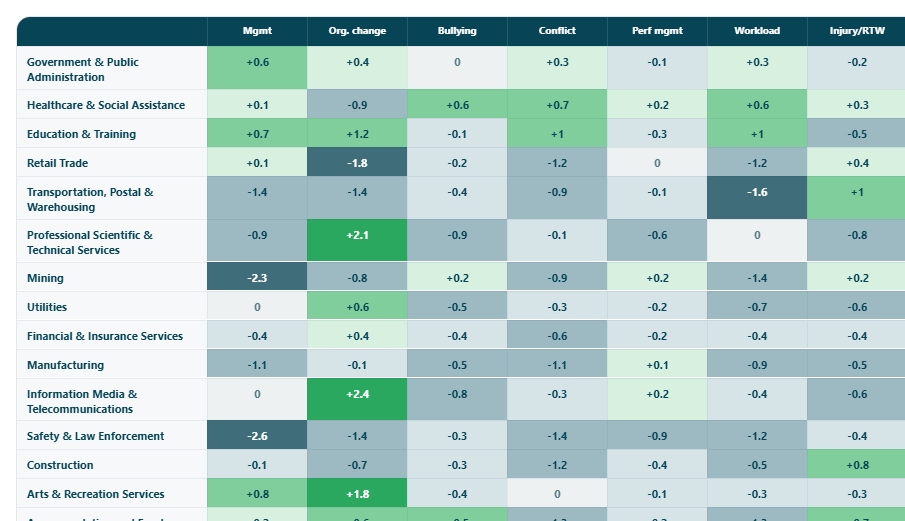
Converge has developed advanced reporting capabilities that help organisations better understand, monitor and manage psychosocial risk. By mapping presenting issues identified through both employee self-reporting data and consultant insights against Safe Work Australia’s 14 psychosocial hazards, organisations can gain a clear view of where risks are emerging and how they are distributed across their workforce. Through intelligent analysis across demographic and workforce segments (including age, gender, tenure, business unit and other relevant groupings), Converge can identify pockets of heightened risk, emerging trends and areas requiring targeted intervention.
Importantly, Converge’s scale provides access to one of the largest sources of workplace wellbeing data, enabling organisations to benchmark their insights against broader industry trends and comparable workforce populations. This benchmarking capability helps leaders understand whether identified risks are unique to their organisation or reflect broader workforce patterns, providing valuable context to inform evidence-based prevention strategies and targeted wellbeing initiatives.
By combining deep workforce insights with industry benchmarks, Converge helps organisations move beyond reactive responses and take a proactive, data-informed approach to creating healthier and safer workplaces. Converge own data, a distinctiveness matrix comparing primary industries and top themes, highlights how they index under or over the Converge wide average:
| Industry | Rel & Family | Parenting | Anxiety | Stress | Phys. health | Depression | Financial | Grief | Legal | Trauma/PTSD | Sleep | Suicidal/SH | DFV | Substance | Loneliness |
|---|---|---|---|---|---|---|---|---|---|---|---|---|---|---|---|
| Government & Public Administration | -1.4 | +0.4 | -0.9 | -0.3 | -0.2 | -0.6 | +0.2 | -0.5 | +0.1 | 0 | -0.2 | -0.4 | -0.2 | -0.4 | 0 |
| Healthcare & Social Assistance | -2 | -1.2 | -0.1 | +1.9 | -0.6 | -0.5 | -0.5 | +0.6 | -1.1 | +0.6 | 0 | -0.1 | +0.2 | -0.2 | -0.1 |
| Education & Training | +1.1 | +1.6 | +2 | +1.7 | +1 | +0.1 | 0 | +0.1 | +0.2 | -0.6 | +0.3 | -0.5 | -0.3 | -0.4 | 0 |
| Retail Trade | -0.9 | -2.8 | +1.5 | -0.5 | +0.8 | +1.9 | -0.1 | 0 | -1.3 | +0.3 | -0.2 | +1.1 | +0.1 | +0.2 | 0 |
| Transportation, Postal & Warehousing | +1.9 | -2.1 | -1.1 | -3.7 | -0.9 | +0.1 | +0.8 | +0.1 | +0.9 | -0.3 | -0.1 | +0.1 | -0.3 | +0.7 | -0.1 |
| Professional Scientific & Technical Services | +3.1 | +0.4 | +0.7 | +0.3 | 0 | +0.4 | +0.5 | -0.3 | +1.5 | -1.3 | +0.2 | -0.3 | -0.3 | -0.1 | +0.1 |
| Mining | +6.9 | +3.3 | -0.1 | -3.6 | +0.4 | +1 | -0.7 | -0.3 | +1.1 | -0.1 | +0.2 | +0.7 | +0.4 | +1.3 | +0.2 |
| Utilities | +1.9 | +0.4 | +0.8 | -1.1 | +0.2 | +0.3 | +0.9 | -0.6 | +0.8 | -1.4 | +0.5 | -0.2 | -0.2 | +0.4 | -0.1 |
| Financial & Insurance Services | -1 | +0.3 | +0.8 | +1.1 | +0.3 | +0.4 | -1.4 | +0.9 | -1.3 | -0.1 | +0.3 | 0 | +0.4 | +0.1 | -0.3 |
| Manufacturing | +5.4 | +2.1 | -0.6 | -0.7 | +1 | +1 | +0.1 | +0.9 | +0.9 | -0.9 | +0.9 | +0.1 | -0.4 | +1.1 | +0.4 |
| Information Media & Telecommunications | +0.5 | +1.8 | 0 | -0.2 | +0.8 | 0 | 0 | +0.3 | +0.8 | -0.9 | +0.1 | -0.4 | +0.1 | -0.1 | 0 |
| Safety & Law Enforcement | +4.1 | +3.2 | -2.1 | -4.3 | -0.5 | -0.2 | -0.9 | -0.6 | +2.4 | +4 | 0 | +0.2 | +0.8 | +0.1 | -0.2 |
| Construction | +9.1 | +3.7 | -1.1 | -2.2 | +2.8 | +1.5 | +1.2 | +1.4 | +1.9 | -0.1 | +1.4 | +4.8 | +0.2 | +4.6 | +0.9 |
| Arts & Recreation Services | +2 | -1.4 | +4.1 | +0.3 | +0.7 | +0.8 | +1 | -0.3 | -0.6 | -0.6 | +0.5 | +0.2 | -0.5 | +0.5 | +0.1 |
| Accommodation and Food Services | -1.9 | -4.1 | +3.2 | -0.6 | -0.6 | +2.3 | +0.5 | -0.7 | -2 | +0.6 | +0.9 | +0.8 | -0.1 | +0.4 | +0.6 |
| Administrative & Support Services | -0.4 | -0.7 | +1.3 | +2.7 | -0.3 | +1.3 | -0.5 | +0.9 | -1.3 | -0.1 | 0 | +0.5 | -0.6 | +0.4 | -0.3 |
| Personal Services | +0.8 | +1.2 | -2.5 | 0 | -0.1 | -0.6 | -1.5 | +0.3 | -0.9 | +0.1 | -0.2 | -0.3 | -0.3 | -0.4 | +0.1 |
| Rental, Hiring & Real Estate | +3 | -1.6 | +0.6 | -0.1 | +0.3 | +0.5 | -1.1 | -0.7 | -0.6 | -0.7 | -0.2 | +0.7 | +1.3 | +1.3 | -0.1 |
| Agriculture, Forestry & Fishing | +1.4 | -0.9 | +2 | +2.3 | -3.1 | -0.9 | -0.1 | -0.3 | +3.1 | +0.1 | +0.1 | +1.3 | -0.4 | -0.4 | -0.3 |
| Industry | Mgmt | Org. change | Bullying | Conflict | Perf mgmt | Workload | Injury/RTW | Critical inc |
|---|---|---|---|---|---|---|---|---|
| Government & Public Administration | +0.6 | +0.4 | 0 | +0.3 | -0.1 | +0.3 | -0.2 | 0 |
| Healthcare & Social Assistance | +0.1 | -0.9 | +0.6 | +0.7 | +0.2 | +0.6 | +0.3 | +0.1 |
| Education & Training | +0.7 | +1.2 | -0.1 | +1 | -0.3 | +1 | -0.5 | -0.1 |
| Retail Trade | +0.1 | -1.8 | -0.2 | -1.2 | 0 | -1.2 | +0.4 | +0.2 |
| Transportation, Postal & Warehousing | -1.4 | -1.4 | -0.4 | -0.9 | -0.1 | -1.6 | +1 | +0.1 |
| Professional Scientific & Technical Services | -0.9 | +2.1 | -0.9 | -0.1 | -0.6 | 0 | -0.8 | -0.1 |
| Mining | -2.3 | -0.8 | +0.2 | -0.9 | +0.2 | -1.4 | +0.2 | +0.1 |
| Utilities | 0 | +0.6 | -0.5 | -0.3 | -0.2 | -0.7 | -0.6 | 0 |
| Financial & Insurance Services | -0.4 | +0.4 | -0.4 | -0.6 | -0.2 | -0.4 | -0.4 | +0.2 |
| Manufacturing | -1.1 | -0.1 | -0.5 | -1.1 | +0.1 | -0.9 | -0.5 | -0.2 |
| Information Media & Telecommunications | 0 | +2.4 | -0.8 | -0.3 | +0.2 | -0.4 | -0.6 | 0 |
| Safety & Law Enforcement | -2.6 | -1.4 | -0.3 | -1.4 | -0.9 | -1.2 | -0.4 | +0.2 |
| Construction | -0.1 | -0.7 | -0.3 | -1.2 | -0.4 | -0.5 | +0.8 | -0.1 |
| Arts & Recreation Services | +0.8 | +1.8 | -0.4 | 0 | -0.1 | -0.3 | -0.3 | 0 |
| Accommodation and Food Services | +0.2 | +0.6 | +0.5 | -1.3 | -0.2 | -1.3 | +0.7 | -0.2 |
| Administrative & Support Services | -1.1 | +0.3 | -0.4 | -0.1 | +0.6 | +0.5 | -0.4 | -0.1 |
| Personal Services | -0.8 | +0.3 | +0.3 | -0.1 | +0.3 | +0.9 | -0.5 | -0.2 |
| Rental, Hiring & Real Estate | -0.2 | +0.2 | -0.7 | -1 | +0.2 | -0.6 | -0.4 | -0.2 |
| Agriculture, Forestry & Fishing | +3.1 | -0.8 | +2.3 | +0.3 | -0.1 | 0 | +0.4 | +0.2 |
Practical implications for employers
Leading organisations should:
- Select EAP providers that can translate workforce data into organisational action
- Establish regular wellbeing reviews with your EAP provider
- Treat EAP insights as an input into WHS and workforce strategy
- Use EAP reporting to identify organisational risk patterns, not simply utilisation rates
- Combine EAP insights with WHS, HR and engagement data
- Review psychosocial risks regularly rather than annually
- Position EAP as part of organisational risk management rather than solely an employee benefit
Trend 2: Prevention is as important as
crisis intervention
“Within the next five years, we expect utilisation rates to be retired as the primary KPI in EAP contracts, replaced by leading indicators such as psychosocial risk trend, engagement scores and manager-confidence scores.”
$6B
lost annually to poor psychosocial safety climate through reduced productivity (Safe Work Australia)
$6.3B
further lost to absenteeism and presenteeism from depression alone (Safe Work Australia)
The traditional EAP model was built around counselling after someone reached crisis. However, prevention is becoming just as important as crisis intervention because organisations are increasingly investing in early support that improves wellbeing before employees reach a point of psychological distress.
Today’s workforce expects support much earlier, while still receiving support during times of high need.
Increasingly, employers are investing in preventative wellbeing strategies including manager coaching, financial wellbeing, nutrition, sleep, resilience, neurodiversity support and digital self-guided resources.
This reflects a broader shift across workplace wellbeing. Organisations are recognising that preventing psychological injury better supports employee wellbeing and can deliver better outcomes for individuals than responding once employees become unwell.
Research consistently shows that psychologically healthy workplaces experience lower absenteeism, lower presenteeism and stronger productivity. Safe Work Australia estimates poor psychosocial safety climate alone costs Australian employers around $6 billion annually through reduced productivity, while depression contributes a further estimated $6.3 billion in absenteeism and presenteeism. (Safe Work Australia)
The role of the EAP is therefore expanding from treatment to include capability building.
The challenge for organisations is avoiding a “wellbeing catalogue” approach. Offering more resources without creating the conditions that allow employees to use them.
Care Anytime, Anywhere: Extending the reach of EAP
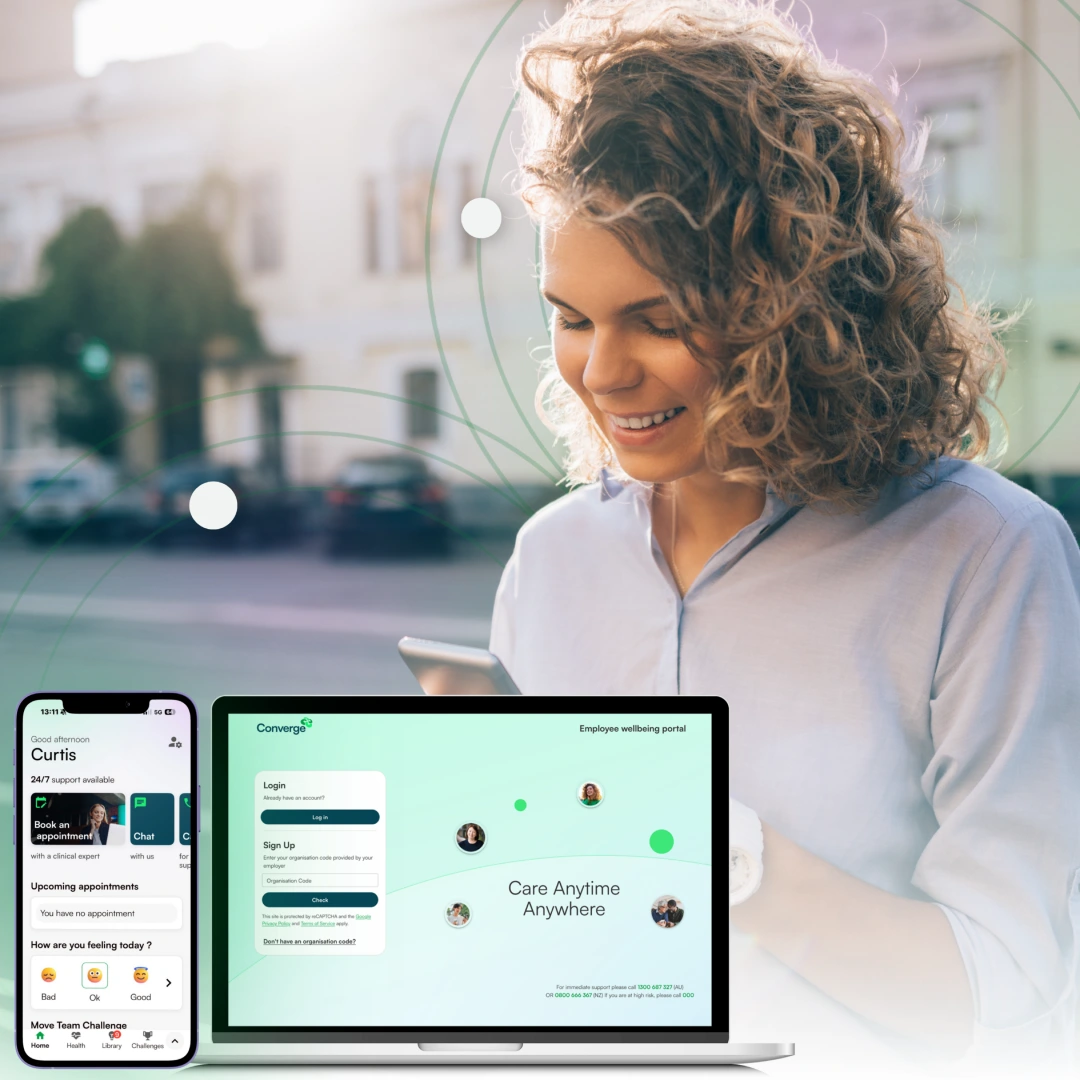
Converge’s vision is “Care Anytime, Anywhere”, making meaningful wellbeing support accessible to employees whenever and wherever they need it. Converge provides free-to-access, easy-to-use wellbeing resources and practical tools for all employees within an organisation, not only those who access counselling. Through the Converge mobile app and Employee Wellbeing Portal, employees have access from day one to a broad range of evidence-informed resources designed to support everyday wellbeing and emerging needs.
This includes topical resources aligned with current workplace challenges and wellbeing trends, a comprehensive wellbeing calendar mapped to key awareness days and seasonal moments, interactive meditation and mindfulness exercises, self-guided wellbeing challenges, videos, podcasts, digital magazines and practical tools employees can engage with at their own pace. By extending support beyond the traditional counselling model, Converge enables organisations to create a more proactive wellbeing ecosystem, helping employees build resilience, access support early and engage with wellbeing in a way that fits their individual needs, preferences and lifestyles.
Many organisations have:
- apps
- webinars
- wellbeing days
- resources
…but still have:
- excessive workload
- poor leadership
- unclear expectations
Prevention is not about adding more wellbeing initiatives; it is about creating workplaces where employees can access support before problems escalate.
Prevention strategies also carry a risk of their own: without structural change to workload, role clarity and leadership behaviour, preventative resources can start to look like organisations outsourcing responsibility for systemic problems onto individual employees. Manager coaching, EAP access and digital tools support prevention, but they don’t replace the harder work of fixing the psychosocial hazards causing the harm in the first place.
Increase of Holistic Wellbeing Support
At Converge, we are seeing strong year-on-year growth in the use of services beyond traditional counselling. Specialist counselling and coaching streams – including Manager Support, Nutrition, Financial Wellbeing, Conflict Support and Career Coaching – are all experiencing increased uptake.
This growth reflects both growing demand for more targeted forms of support and the impact of Converge’s ongoing investment in product innovation and targeted marketing and communications. By expanding the range of support available and making these services more visible and accessible, we are enabling more people to access the right support for their specific needs.
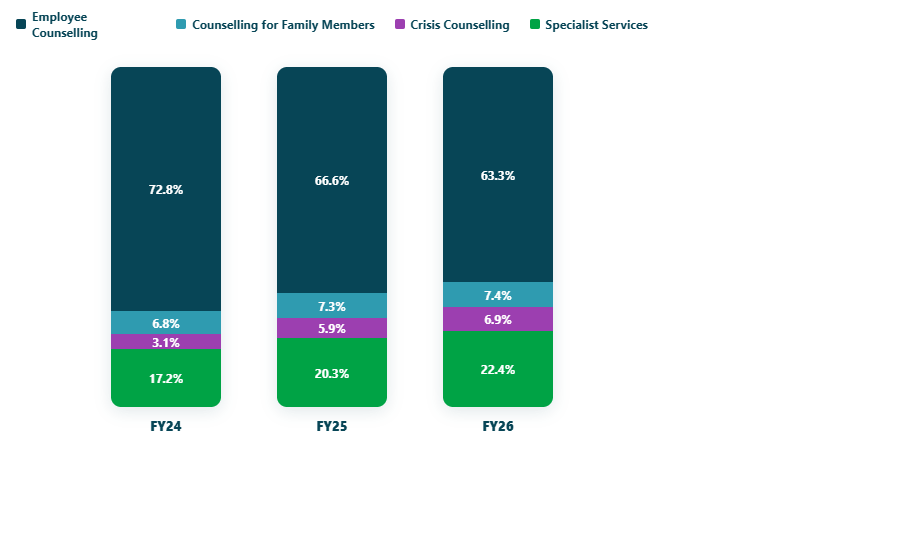
| Year | Employee Counselling | Counselling for Family Members | Crisis Counselling | Specialist Services |
|---|---|---|---|---|
| FY24 | 72.8% | 6.8% | 3.1% | 17.2% |
| FY25 | 66.6% | 7.3% | 5.9% | 20.3% |
| FY26 | 63.3% | 7.4% | 6.9% | 22.4% |
57% increase in digital reach over the last 12 months (FY25)
More than 50% of first appointments are now booked online through the Converge app and Online Wellbeing Portal, demonstrating a clear shift towards digital access to wellbeing support.
We measure digital reach by tracking the number of people accessing Converge services, support and wellbeing resources through our digital channels. Data from the past 12 months shows a 57% year-on-year increase in digital reach, reflecting growing engagement with digital pathways and resources as part of the overall wellbeing experience.
Practical implications for employers
Rather than measuring success by counselling sessions delivered, organisations should consider:
- wellbeing education throughout the employee lifecycle
- digital resources available between appointments
- specialist support streams for emerging workforce needs
- proactive campaigns focused on prevention rather than awareness alone
- integrating EAP into broader wellbeing and learning strategies
Trend 3: Managers are the frontline of
workplace wellbeing
“Organisations that fund structured manager mental health capability training now are likely to see measurable reductions in absenteeism and safety incidents within the next couple of years, consistent with the scale of impact Gallup’s research points to.”
-41%
potential reduction in absenteeism from doubling employees who feel genuinely cared for by their manager (Gallup)
-46%
potential reduction in safety incidents from the same effect (Gallup)
Managers are increasingly recognised as the frontline of workplace wellbeing because they influence psychological safety, employee engagement and early intervention more than any other workplace role.
Research continues to demonstrate that an employee’s immediate manager has one of the greatest influences on workplace wellbeing.
Managers are increasingly expected to identify early signs of distress, lead psychologically safe teams, navigate organisational change and support employees experiencing mental health challenges.
Yet many managers feel underprepared for these responsibilities.
A manager is often the first person to notice when something has changed. A normally engaged employee withdrawing from meetings, a team member struggling after organisational change, or someone whose performance begins to decline. The question is not whether managers will encounter these moments; it is whether they feel equipped to respond.
Gallup’s workplace research shows that employees who feel genuinely cared for by their manager experience substantially better outcomes. Gallup estimates that doubling the proportion of employees who strongly agree their supervisor cares about them could reduce absenteeism by 41% and safety incidents by 46%. (Gallup.com)
Expanding the manager’s role in wellbeing is not without cost. Managers already carry significant operational load, and adding mental health support without adequate training, time and consideration of manager needs can increase manager burnout rather than reduce team-level harm. Organisations need to resource manager capability-building as a genuine investment, not an unfunded expectation layered onto existing roles. This needs to go hand in hand with the continued messaging of mutual responsibility for psychosocial risk management between organisation, manager and employee.
As organisations face ongoing restructuring, technological change and economic uncertainty, supporting managers has become one of the highest-impact wellbeing investments available.
Increasingly, EAPs are expanding beyond employee counselling to include manager coaching, leadership consultation and difficult conversation support.
Converge Leaders Corner: Supporting the people who support others
At Converge, this evolution is reflected through initiatives such as Leaders Corner: a dedicated space designed to equip managers with accessible, practical resources to navigate the human side of leadership. Leaders Corner provides managers with guidance on topics such as recognising signs of distress, having difficult conversations, supporting employees through challenges and knowing when to connect people with additional support. By putting evidence-informed resources directly into the hands of leaders, Converge helps organisations build manager capability and create healthier, more supportive workplaces where wellbeing becomes part of everyday leadership.

The Value of Manager Support
Converge data further demonstrates the value of Manager Coaching, with organisations showing higher engagement in this service experiencing fewer reported issues relating to workplace risk factors, including relationships, satisfaction and performance.
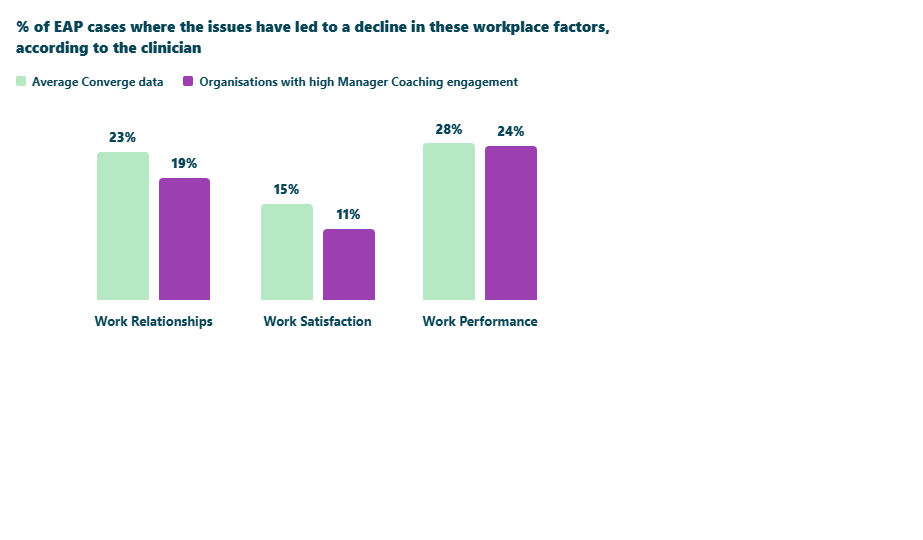
| Workplace factor | Average Converge data | Organisations with high Manager Coaching engagement |
|---|---|---|
| Work Relationships | 23% | 19% |
| Work Satisfaction | 15% | 11% |
| Work Performance | 28% | 24% |
(based on sample size of 4032 cases for the organisations with high Manager coaching engagement)
Practical implications for employers
High-performing organisations should:
- provide dedicated manager support services
- equip leaders to recognise psychosocial hazards early
- train managers in psychologically safe conversations
- provision of employee support and accountability
- Support managers to maintain healthy professional boundaries to ensure sustainable
- ensure managers understand when and how to refer employees to support services
- measure manager capability as a leading indicator of workforce wellbeing
Trend 4: AI is reshaping both
work and wellbeing
“Expect AI-enabled triage and resource-navigation tools to become standard across EAP providers within the next 24 months. The differentiator will not be whether providers use AI, but whether they can demonstrate the governance, privacy and clinical oversight to use it responsibly.”
70%
of EAP professionals believe AI will play a significant role in service delivery (EAPAA)
87%
view selling client data as unethical, reinforcing trust as foundational (EAPAA)
Artificial intelligence is reshaping workplace wellbeing by improving accessibility, personalisation and operational efficiency, while expert human care remains essential for clinical support. In current working environments, AI is actually transforming workplaces at unprecedented speed. While much of the discussion has focused on productivity, automation and efficiency, organisations are increasingly recognising that AI is also a workforce wellbeing issue.
Employees are not only learning how to use new technology; they are adapting to uncertainty about how work itself will change. Questions around job security, changing roles, new skill requirements and increasing expectations are creating new challenges for employee wellbeing.
AI therefore represents a dual challenge for organisations: managing the human impact of technological change while responsibly harnessing technology to improve access to support.
The EAP sector is approaching AI with cautious optimism
Research conducted by EAPAA research partners Mark Attridge and Daniel Hughes provides important insight into how the EAP profession is responding to AI. The research found that more than 70% of EAP professionals believe AI will play a significant role in the future of service delivery. However, adoption is being approached carefully, with privacy, data security, clinical accuracy and the absence of genuine human empathy identified as key concerns. (EAPAA)
This suggests that the future of AI in EAP will not be driven by replacing human support with automated solutions. Instead, the industry is moving towards a more considered model where technology enhances accessibility, efficiency and personalisation while preserving the human connection at the centre of effective mental health support.
These concerns are not hypothetical. Poorly governed AI deployment in a mental health context carries real risk: inaccurate triage, opaque data handling, or a loss of the human judgement that clinical support depends on. Organisations should treat “does this AI tool actually improve outcomes for our people” as a harder bar than “does this AI tool reduce cost or handling time” – the two are not the same question, and only the first justifies deployment in a wellbeing context.
Where AI can add value
The EAPAA research highlights that the strongest perceived opportunities for AI are currently operational rather than replacing clinical care. EAP professionals see potential in areas such as:
- improving administrative efficiency
- supporting data consolidation and reporting
- helping employees navigate available resources
- assisting clinicians with information and workflow support
- creating more personalised digital experiences
This represents an important distinction. The opportunity is not to digitise counselling; it is to remove barriers that prevent people from accessing the right support at the right time.
Trust will determine the future of AI-enabled wellbeing
Mental health support depends on trust. Employees need confidence that their information is protected, their privacy is respected and technology is being used ethically.
The EAPAA research found strong concerns about responsible data use, with privacy and ethical considerations emerging as central issues. For example, 87% of respondents viewed selling client data as unethical, reinforcing that trust and confidentiality remain foundational principles for the sector.
For employers, this means selecting wellbeing technology partners that can demonstrate strong governance, transparency and clinical oversight.
The human element cannot be automated
While AI can improve access and efficiency, it cannot replicate the empathy, judgement and therapeutic relationship that underpin effective psychological support.

“AI has enormous potential to improve how people access wellbeing support, from helping employees find relevant resources faster to enabling more personalised experiences. However, technology must always be designed around people, not replace the human connection that sits at the heart of effective and objective mental health support.”
Cate Page
Chief Clinical Officer, Converge
Practical implications for employers
Organisations should:
- treat AI adoption as a people and change management challenge, not only a technology implementation
- communicate clearly with employees about how AI will affect roles and expectations
- identify emerging psychosocial risks associated with technological change
- ensure AI-enabled wellbeing tools have strong privacy, ethical and clinical governance frameworks
- prioritise solutions that enhance human care rather than attempt to replace it
- partner with EAP providers who are actively shaping responsible AI adoption in workplace mental health
Trend 5:Organisations are demanding measurable wellbeing outcomes
“By the end of the decade, we expect wellbeing reporting to sit alongside safety and financial reporting at board level for large employers — organisations that build this measurement capability early will have a multi-year head start on the evidence base needed to justify wellbeing investment.”
Organisations are increasingly demanding measurable wellbeing outcomes to demonstrate the impact of workplace wellbeing investments on people, culture and organisational performance. Therefore, perhaps the biggest commercial shift is changing expectations around measurement.
Historically, EAP reporting centred on utilisation rates. Today’s boards want evidence that wellbeing investments improve organisational performance.
For years, the success of an EAP was often judged by one number: utilisation. A higher rate was celebrated as evidence employees were accessing support. A lower rate was often interpreted as a failure of engagement. But utilisation alone tells only one part of the story.
Increasingly, employers are asking questions such as:
- Are psychosocial risks reducing?
- Are managers becoming more confident?
- Is employee engagement improving?
- Are psychological injury claims declining?
- Are wellbeing initiatives improving retention and productivity?
Leading organisations now expect wellbeing data to inform strategic decisions, much like financial or operational reporting.
The future of EAP reporting lies in actionable workforce intelligence rather than descriptive activity reporting.
A mature measurement framework includes:
ACCESS
Utilisation · Reach · Demographics
EXPERIENCE
Satisfaction · Clinical outcomes · Confidence
ORGANISATIONAL IMPACT
Psychosocial risk trends · Absenteeism · Retention · Manager capability
Measurement maturity carries its own risk if pursued carelessly: chasing metrics that are easy to collect (utilisation, satisfaction scores) rather than metrics that matter (psychosocial risk trend, manager capability, claims reduction) can produce reporting that looks rigorous without being decision-useful. Employers should interrogate whether a metric changes a decision before adding it to a dashboard.
Partnership Approach
As organisations demand greater value from their wellbeing investments, the role of EAP providers is evolving. The future of EAP is not simply about delivering a service when an employee reaches out for support; it is about partnering with organisations to understand their workforce, anticipate challenges and design wellbeing strategies that create meaningful impact.
At Converge, we take a partnership approach, working alongside organisations to embed wellbeing into their broader people, safety and culture strategies. Through dedicated account support, workforce insights, tailored engagement plans, leadership resources, campaigns and targeted initiatives, Converge helps organisations move from reactive support to proactive wellbeing.
This partnership model recognises that every organisation has different workforce needs, challenges and priorities. By combining clinical expertise, workforce insights and deep organisational understanding, Converge works collaboratively with clients to identify opportunities, measure progress and continuously improve the way wellbeing support is delivered.
The future of EAP is not a one-size-fits-all service; it is a trusted partnership that helps organisations create healthier, more resilient workplaces.

Practical implications for employers
Employers should consider measuring:
- wellbeing outcomes
- psychosocial risk indicators
- manager capability
- wellbeing engagement across different workforce segments
- productivity measures such as absenteeism and presenteeism
- return on investment from preventative wellbeing initiatives
- organisational trends rather than utilisation rates alone
Outcomes
At Converge, we measure wellbeing outcomes using a wellbeing survey informed by the Feedback-Informed Treatment (FIT) approach, an evidence-based method developed by psychologist Scott Miller.
Clients who access counselling are invited to complete the survey before and after their appointment, enabling us to measure changes in wellbeing over the course of their support.
The chart below shows the distribution of wellbeing scores before a client’s first counselling appointment compared with their scores following the session. The results demonstrate a measurable improvement in wellbeing following just one session, highlighting the potential impact of timely, early intervention.
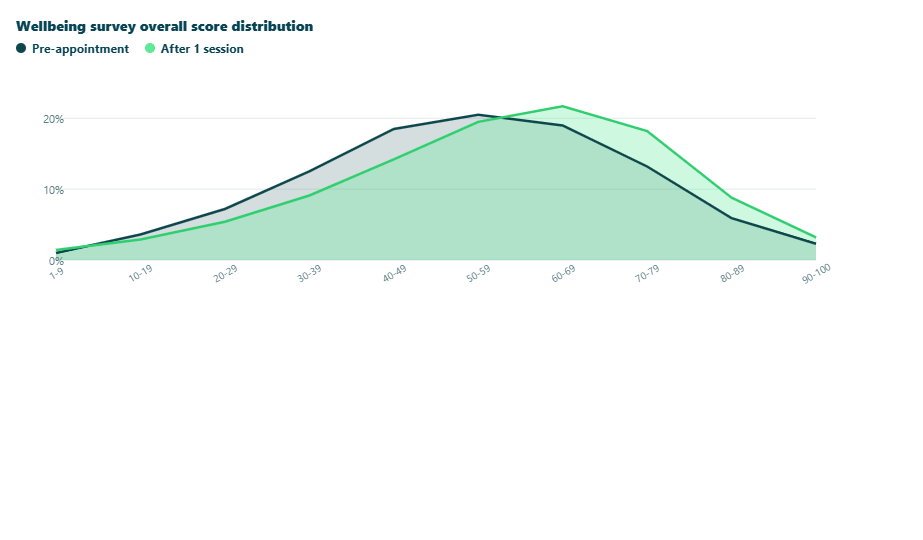
| Score band | Pre-appointment | After 1 session |
|---|---|---|
| 1-9 | 1% | 1.4% |
| 10-19 | 3.6% | 2.9% |
| 20-29 | 7.2% | 5.4% |
| 30-39 | 12.5% | 9.1% |
| 40-49 | 18.5% | 14.2% |
| 50-59 | 20.5% | 19.5% |
| 60-69 | 19% | 21.7% |
| 70-79 | 13.2% | 18.2% |
| 80-89 | 5.9% | 8.8% |
| 90-100 | 2.3% | 3.2% |
of respondents saw a boost in overall wellbeing — averaging a 29% increase — after just one session of Employee Counselling or Manager Support.
| Metric | Value |
|---|---|
| Respondents who saw a wellbeing boost | 66% |
| Average increase among those who improved | 29% |
| Outcome | Share of cases |
|---|---|
| Within EAP program | 87% |
| Referred for ongoing support | 13% |
Conclusion
The future of EAP is not about replacing counselling. Counselling remains a critical and often life-changing intervention. The future is about expanding the role of EAP so organisations can prevent harm, identify risks earlier, support leaders and make better decisions about workforce wellbeing.
They are evolving into strategic workplace wellbeing partners that help organisations prevent psychological harm, strengthen leadership capability, navigate technological disruption and make better decisions using workforce insights.
The organisations that act on these trends now will be better positioned than those that wait for regulation, a claims spike, or a board question to force the issue.
If you want to know where your organisation sits against these five trends, Converge can help you find out. Speak with your Converge account partner about a psychosocial risk benchmarking review, or contact our team to arrange a workforce wellbeing insights session tailored to your organisation.
Learn more about our employee wellbeing solutions