Employee Assistance Program (EAP): The Complete Guide for Australian Employers
A comprehensive guide to Employee Assistance Programs (EAP) in Australia for employers. Gain an understanding of what EAP is and how it supports employee wellbeing. Learn how our counselling and wellbeing services provide holistic, urgent and proactive care, anytime, anywhere.


Key facts
An EAP at a glance
Employee Assistance Programs are employer-funded mental health and wellbeing support services, delivered to employees free of charge and confidentially. They combine technology with expert human care.

Clinically reviewed by Cate Page, Chief Clinical Officer, Converge
Cate Page is Chief Clinical Officer at Converge International and a Mental Health Social Worker. She has more than 20 years’ experience in Employee Assistance Programs, workplace mental health and organisational consulting. She previously managed the Beyond Blue National Workplace Program. At Converge, Cate leads clinical governance and service quality, specialising in psychosocial safety, leadership wellbeing and mentally healthy workplaces.
Last updated: 30 October 2026

What is it?
Confidential wellbeing support for work and personal issues.

Who pays?
Employers pay for counselling and coaching services – EAP is free for employees.

Who can use it?
Employees and their immediate family members.

Confidentiality?
Session and employee data is never shared. The only information provided to employers is de-identified, aggregated data.

How to access
Phone, app, portal, live chat, and WhatsApp provide simple and comfortable booking avenues for employees.
EMPLOYEES
Looking for support? Head to the Converge App or the Employee Wellbeing Portal to book support.
01 | DEFINITION
What is an Employee Assistance Program (EAP)?
QUICK ANSWER
Employee Assistance Programs are employer-funded mental health and wellbeing counselling and coaching services. They’re provided to employees free of charge and confidentially, for personal and professional challenges. Eligible employees and their immediate family members can access the program, where support is delivered by a qualified and experienced clinician or coach.
These include:
- Psychologists
- Counsellors
- Social workers
- Financial or career coaches
- Dietitians and nutritionists
- Lawyers
Modern EAP providers, including Converge, pair expert human support with digital wellbeing tools. This enhances employees’ access to care and enables greater proactivity in managing their wellbeing. To achieve this, apps and portals house resources, webinars, and modules, promoting self-guided preventative care. But when a wellbeing crisis occurs, 24/7 support is available through critical incident response and crisis counselling. Organisations of any size can benefit from an Employee Assistance Program.
What does EAP stand for? EAP meaning explained
EAP stands for Employee Assistance Program (or programme in New Zealand). It encompasses all the mental health and wellbeing support an employee accesses from the independent provider who delivers care on the employer’s behalf.
Who can use an Employee Assistance Program?
Eligibility depends entirely on the contract agreed by the organisation. In most cases, EAP is accessible to full-time, part-time and casual employees, regardless of role. For example, managers and casual store employees can book support. In some cases, organisations may have members or contractors. The same support delivered to employees could also be extended to them. Depending on the EAP provider, immediate family members can also access support. Immediate family members are often categorised as parents or guardians, partners, siblings, grandparents, dependants and people living in the same household as the employee – such as house mate.
How workplace counselling programs evolved into a wellbeing ecosystem
1
2
3
1970s to 90s
Reactive support
Support was reactive, often only accessed when an employee was in a mental health crisis. Workplaces primarily focused on physical wellbeing.
2000s to 2010s
Focus shifted to psychological wellbeing
Australia began to treat psychological injuries as seriously as physical ones, making EAP more essential.
2020s to today
Psychosocial safety was legislated
Workplaces must abide by new psychosocial legislation, with EAP being a significant control measure. Digital technology also grew to enhance access and proactive learning.
02 | HOW IT WORKS
How does an Employee Assistance Program work?
QUICK ANSWER
Employee Assistance Programs work by providing employees with free access to experienced and expert clinicians and coaches to improve their mental health and wellbeing. Because employers fund the program, employees can use digital tools and contact centres to book care, often within hours or days. This removes the cost barrier and the long wait times common in private practice.
Employees can access care in a number of ways, including:
- Face-to-face
- Telehealth
- Virtually
To maintain trust in the program, an EAP is an independent, third-party provider, bound by strict privacy and confidentiality requirements. EAP providers only share aggregated, de-identified data with an organisation, which helps it shape initiatives around wellbeing trends. Names and identifiable data are never shared, upholding employees’ privacy and the EAP’s legal obligations.
How employees access EAP support with Converge
Support that’s accessible 24/7
Phone Support
Wellbeing App
Online Portal
1
Seeking Support
The employee reaches out to their EAP via the provider’s wellbeing app, portal or phone line. No referral or employer approval needed.
Here is how your staff register →
2
Triage
During intake, employees provide their details and a short description of their issue. This applies whether they book in the app, the portal or through our contact centre. If urgent support is required, the employee calls our contact centre, and the agent will transfer the employee to a clinician. A clinician is also available to reach out to employees within 20 minutes if this is the employee’s preference.
3
Matched with the right clinician
The contact centre agent, or our smart booking algorithm for online bookings, will match the employee with the best clinician based on the employee’s issue, preference and location.
4
Session & follow-up
Once the booking is complete and email and/or SMS confirmation is received, the employee is all set for their session. Employees can book 3 to 6 sessions per year, depending on their organisation’s EAP contract, and the clinician will refer them on if longer-term care is needed.
Is EAP confidential? What an employer can and can’t see
✔ Organisations can see…
- De-identified, aggregated outcomes data
- De-identified utilisation and engagement rates
- Aggregated issue trends
✕ Organisations can’t see…
- Who used the service
- What was discussed during the session and intake
- Any case notes written by the clinician
How managers can refer an employee to EAP at Converge
Managers have the ability to refer an employee to EAP support, but only with the employee’s consent. Should the employee give the okay, their manager can book an EAP session for them. The manager can call the contact centre or sit with the employee to book through their app or portal. When the manager contacts our contact centre, they tell the agent they’re supporting an employee and confirm that consent was provided. They then give the individual’s details and a description of the issue.
This is where the involvement of a manager stops. Confirmation of booking is sent to the employee only. Any information, such as whether the employee attended the session and what was discussed, is not shared with anyone, including the manager. As always, attendance is voluntary.
“
Supporting employees is not only good for business, but it’s also the right thing. We strive to provide employees with the highest quality support, delivered through our experienced clinical team. When an employee is in crisis, we’re there. When an employee wants to seek proactive care to minimise the risk of an issue escalating, we’re here. For any of life’s challenges, both at work and at home, we’re always here to deliver care anytime, anywhere.”

Mitch Robson · Counsellor and Clinical Manager, Converge
03 | SERVICES
What services does an Employee Assistance Program provide?
QUICK ANSWER
EAP providers offer confidential, solution-focused and evidence-based mental health, wellbeing and workplace support services to employees and their immediate family members. Depending on the provider, this includes counselling, family and relationship support, specialised coaching, 24/7 crisis and trauma support, and leadership guidance. Three core services offered through an EAP are confidential counselling, critical incident support and manager support.
These counselling and coaching services can include:
- Confidential, solution-focused counselling to overcome a range of personal or professional mental health challenges, including stress and anxiety
- Personal and family support for relationship breakdowns, parenting challenges, domestic violence, and general life transitions, such as retirement
- Specialised coaching offering guidance on career development, personal finances, nutrition and diet, sleep, mindfulness and managing conflict
- 24/7 crisis counselling and trauma support for when a critical incident occurs or an employee is in distress
- Leadership development and guidance on supporting employees with a mental health condition, navigating challenging conversations and managing wellbeing
Converge’s EAP, training and consulting services
At Converge, we provide 9 core EAP streams and 7 specialist helplines, plus training and development, and risk management and safety services. Each support stream is delivered by a qualified clinician or coach with more than 3 years of experience in their specialist field. Similarly, our specialist helplines are delivered by clinicians who have specialised training and/or lived experience in specialist areas, such as First Nations support and menopause.
On top of our counselling and coaching streams, we also provide organisations and their employees with a range of digital wellbeing platforms. These include the Converge App and the Employee Wellbeing Portal, housing tools, modules, challenges, articles, tipsheets, podcasts, videos and webinars. Our support services can help employees experiencing:
- Stress, anxiety and depression
- Burnout or distress
- Relationship and family issues
- Addictive behaviours
- Sleep issues
- Identity and belonging concerns
- Leadership struggles
- Other common issues that affect mental health and wellbeing
Types of EAP support: counselling, training, risk and critical incident
Our support options can be broken down into four categories, all designed to provide holistic support that covers all employee wellbeing needs and situations.
EAP Support

- Employee and family member counselling
- Financial, career, conflict, and manager coaching
- Legal, neurodiversity, and nutrition support
- 7 specialist helplines
Training & Development

- Change management and outplacement support
- Leadership and career development
- Coaching, seminars, webinars, and eLearning
- Executive leadership coaching
Risk Management & Safety

Planned, Critical Incident and Onsite Support

- Support for planned events
- Critical incident response services for unplanned crises
- Crisis counselling and disaster management
- Onsite wellbeing support where we bring a clinician to you
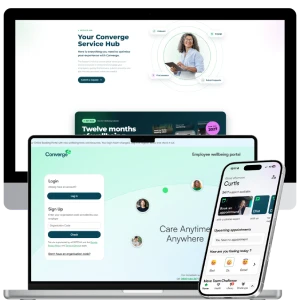
Converge Digital Wellbeing Tools
Converge App | Employee Wellbeing Portal | Service Hub
- Live Chat & 24/7 Online Booking
- Articles & Tipsheets
- Videos & Podcasts
- Modules & Challenges
- Bank of Resources
Which EAP package fits?
04 | BENEFITS & ROI
What are the benefits of an Employee Assistance Program?
QUICK ANSWER
The primary benefit of an Employee Assistance Program is that care is immediate, confidential, convenient and flexible. It’s delivered by expert practitioners for any personal or work-related issue. EAP is designed to support employees before an issue escalates, making EAP counselling an essential early intervention tool.
Should a challenge escalate, EAP providers also offer 24/7 crisis counselling to ensure employees receive the care they need when they need it. Equally, EAP providers give employees access to digital tools and resources that help them identify their stressors and proactively manage their wellbeing. This ultimately aids them in developing ongoing coping mechanisms and strategies.
The ROI of EAP depends on headcount, absenteeism costs and how well the EAP is promoted. ROI can be calculated by understanding rates of turnover, absenteeism, mental health claims, and productivity. Start by tracking these measures against utilisation and engagement: if they fall as use rises, you can start to quantify the EAP’s effectiveness and ROI. According to 2014 PwC research, EAP and workplace wellbeing programs have an average positive return on investment of $2.30 for every dollar spent.
✔ Benefits for employees
- Support everyday wellbeing challenges occurring both inside and outside of work – including stress, depression, burnout, and anxiety
- Care can be accessed for any stage of an employee’s wellbeing journey – from minor wellbeing challenges to severe, crisis-level issues
- Flexible access means employees can book care in whichever way is most comfortable for them
- Managers can access tailored support to effectively help employees in distress and further develop their leadership skills
- Support is entirely confidential – organisations and leaders only see de-identified, aggregated data
✔ Benefits for employers
- Reduction in absenteeism and presenteeism
- Increase in productivity, focus, and engagement
- Reduced turnover, and a more attractive employer brand for new talent
- Creating more capable managers and leaders
- A recognised control for psychosocial risk when promoted effectively
- Fewer mental health-related workers’ compensation claims
- Less negative conflict and more harmonious teams
What Converge data says about the benefits of EAP support
87%
employee satisfaction rate
87%
of employees established a positive relationship with their clinician or coach
67%
of employees saw a significant boost in their wellbeing after only one session
Converge client data obtained through anonymised employee feedback surveys during the 2026 financial year.
“
EAP has many benefits for both organisations and employees. For staff members, they’re able to gain the support they need early, preventing any personal and work-related challenges from growing. Similarly, if a crisis hits, we’re there to help them through it and get them back to their best. On the organisation side, employers can see significant increases in productivity, focus and engagement, leading to better ROI and profitability. In reality, EAP should always be an investment an organisation explores, as it’s no longer a nice-to-have. In fact, it’s a must-have.”

Marylise Talbot · Executive Director of Digital, Converge & EAPAA President
05 | LEGAL
Is EAP a legal requirement in Australia?
QUICK ANSWER
While no law requires organisations to have an EAP, they do have a legal obligation to manage psychosocial risks in their workplace. Safe Work Australia identifies 14 psychosocial hazards, which organisations must identify and manage where present. State and territory regulators, and Comcare for Commonwealth workplaces, enforce these duties.
Explore our range of psychosocial risk assessment packages →
State-by-state psychosocial regulations
If an organisation is found non-compliant, it can face significant financial repercussions and reputational damage. One measure a company can take is implementing an EAP, as it’s widely considered a recognised control. An EAP alone doesn’t make an organisation compliant, but it helps employees with workplace challenges such as bullying, burnout, stress, and conflict. An EAP can also help address other hazards, including poor workplace support and managing job demands. It can support employees working through traumatic events and reduce team conflict and relationship issues.
To identify the hazards in your workplace and work towards compliance, Converge offers comprehensive psychosocial risk assessments. Our assessments are designed to locate the risks present in your workplace and offer guidance on control measures. We also educate you on how to implement those controls for measurable impact.
| Jurisdiction | Regulation / guidance | Status |
|---|---|---|
| Commonwealth | WHS Regulations, psychosocial amendments + Model Code of Practice | In force |
| NSW | WHS Regulation + Code of Practice: Managing psychosocial hazards | In force |
| VIC | OHS (Psychological Health) Regulations 2025 | In force |
| QLD | WHS Regulation + Managing the risk of psychosocial hazards Code | In force |
| WA | WHS Regulations + Psychosocial hazards Code of Practice | In force |
| SA | WHS Regulations, psychosocial amendments | In force |
| TAS | WHS Regulations, psychosocial amendments | In force |
| ACT | WHS Regulation + approved Code of Practice | In force |
| NT | WHS Regulations, psychosocial amendments | In force |
| New Zealand | Health and Safety at Work Act 2015 (WorkSafe NZ guidance) | In force |
Sources: Safe Work Australia, WorkSafe Victoria, SafeWork NSW, WorkSafe NZ
The process of identifying psychosocial risk in your workplace
1
2
3
Identify hazards
Start by identifying the hazards present, such as job demands, low control and poor support via employee feedback and pulse surveys.
Consult with employees
Conduct employee consultations and focus groups to understand their experiences and what hazards they’re facing.
Read the data
Work through the data to then fully understand what risks are present, which will inform your control measures and initiatives.
Make feedback anonymous or voluntary so employees don’t fear repercussions.
Read our article on psychosocial risk assessments and how to manage hazards in the workplace →
At Converge, we can map the anonymised issues your employees seek EAP support for against the 14 psychosocial hazards. This helps you identify where risks sit within your organisation.
How psychosocially safe is your organisation?
Does your organisation have clear processes to identify, assess and control psychosocial hazards, such as low job control, poor support, and exposure to trauma?
Do you have a process to consult with workers when they’re likely to be exposed to a psychosocial hazard? For example, organisational change, high job demands and exposure to workplace violence.
Are workers encouraged and supported to report psychosocial concerns without fear of stigma or negative consequences?
Please fill out our form to get in touch with our psychosocial risk team. They will be able to support you with your organisation's risk profile and explain our packages in greater detail.
How an EAP supports psychosocial risk management
Pair your EAP with a structured psychosocial risk assessment to meet your duties and responsibilities with confidence.
Download our psychosocial risk assessment guide
Learn the process of a psychosocial risk assessment: how to identify risks in your workplace and develop control measures for healthier and safer workplaces.
06 | COST
How much does an Employee Assistance Program cost?
QUICK ANSWER
The cost of an Employee Assistance Program depends on headcount, utilisation rate, session allowances, services included, and how your employees receive support (face-to-face or virtually). There are typically two types of charges: pay per employee or pay for what your employees use. Both are usually combined with a monthly or annual management fee. This cost is never passed on to your staff.
Common EAP pricing models
Pay per employee
A fixed annual fee per employee.
Pros:
Predictable budgeting
Usage doesn’t change cost
Cons:
Doesn’t factor in utilisation rates
Can be expensive for large organisations
Fee for service
Pay per session that your employees use.
Pros:
You only pay for what you use, with greater transparency
Lower financial barrier – can cost less for small and medium organisations
Cons:
Unpredictable budget forecasting
Which pricing model is right for you?
The pricing model for you depends on what your EAP needs are. If you’re looking for a set-and-forget budget that does not fluctuate, a per employee per annum (PEPA) or retainer model could be the better option. However, as you scale or if your utilisation rate is low, you could be paying more than you need. On the other hand, a pay-for-what-you-use model may suit you better if you’d rather pay only for sessions used. Setting a session allowance still lets you forecast spend. To pick the right pricing model for your organisation, firstly explore the value of the package. For example, do they offer resources and tools in the management fee? Secondly, identify the experience and expertise of the clinicians delivering support. Thirdly, check whether their services are holistic and include wellbeing supports, such as career and financial coaching, in addition to mental health counselling.
What affects the cost of EAP services
Headcount
Sessions and utilisation
Specialist services
Reporting depth
Critical incident cover
Location
Counselling delivery
Family coverage
Common myths about EAP costs
The price is the bit everyone sees. Dive in to bust the myths underneath.
The reality: Nothing. The employer funds the EAP, so it's free at the point of use for employees and, on many plans, their families.
The reality: Fee-for-service and small business plans scale down to teams under 50, so you pay for what your people actually use.
The reality: Having support in place is a recognised control for psychosocial risk. Low use may mean low awareness, which promotion and manager training can fix.
The reality: Value comes from response times, clinician quality, national reach and reporting.
The reality: Most value comes from early, everyday support: talking things through before stress turns into absence, conflict or a resignation.
Is EAP worth it for you?
Explore our cost-effective and tailored EAP packages
Click the button to explore our packages and lodge an enquiry with our team. We’ll take you through your options and help you pick the right wellbeing solution for your organisation.
07 | CHOOSING A PROVIDER
How to choose the right EAP provider
QUICK ANSWER
When choosing an Employee Assistance Program, look for qualified clinicians, national or international coverage, and diverse counselling delivery – including face-to-face, virtual, and telehealth. You also need to assess their digital capabilities: do they have an app and what does it feature? Also assess their reporting depth, and whether they provide crisis counselling and critical incident support.
The right provider scales with your organisation and supports small and medium businesses, government and enterprise alike. Its human support is backed by digital technology, resources and tools.
10 questions to ask an EAP provider
Are your clinicians qualified, experienced and registered?
Can you deliver face to face nationally and in the areas where coverage is needed?
What reporting will we receive, and how often?
Will you support us in promotion and awareness campaigns?
What digital tools come included?
How do you respond to critical incidents?
Which specialist services are available?
Do you support family members?
How do you lift utilisation?
Can the service scale as we grow?
How does Converge compare?
At Converge, we provide comprehensive wellbeing services for all your employees and their immediate family members. Our focus is holistic support for all personal and work-related issues and challenges. To do this, we provide 9 counselling streams, 7 specialist helplines, training and consulting. In addition, as part of our packages, your organisation receives access to our digital platforms: the Converge App, Wellbeing Portal and Service Hub. They house resources, webinars, tipsheets, posters, modules, challenges and more. We meet every criterion covered in this section. We’re a trusted, industry-leading Employee Assistance Program, and we’d be honoured to support your people. Explore how our workplace wellbeing solutions support SMBs, enterprise and government.


08 | COMPARISONS
EAP vs private psychology: what’s the difference?
QUICK ANSWER
Employee Assistance Programs offer fast, free, and expert clinical support to employees and their families. A private psychologist on a Mental Health Treatment Plan suits longer-term care, but needs a GP referral, usually involves a gap fee and can take weeks to book. The two work together: EAP clinicians can refer employees when ongoing treatment is needed.
| EAP | Psychologist (MHTP) | Converge EAP & wellbeing | |
|---|---|---|---|
| Cost to employee | ✔︎ $0 | ✕ Gap fee often applies | ✔︎ $0 for employees and their families |
| Speed of access | ✔︎ Usually within days | ✕ GP referral, then weeks | ✔︎ Same day, often minutes. Crisis support delivered immediately |
| Who’s covered | ✔︎ Employees, often family | – The individual | ✔︎ Employees and immediate family |
| Confidentiality | ✔︎ Confidential | ✔︎ Confidential | ✔︎ Fully confidential, ISO 27001 certified |
| Qualified clinicians | ✔︎ Yes, varies by provider | ✔︎ Registered psychologist | ✔︎ 2,000+ clinicians and coaches, matched to need |
| Longer-term care | – Short-term, refers on | ✔︎ Suited to ongoing treatment | ✔︎ Early intervention, with clinician referral to ongoing care |
| Session limits | – Set by the employer’s EAP package | – Up to 10 Medicare-rebated individual sessions per calendar year (Better Access) | ✔︎ 3 to 6 sessions per year, with clinician referral pathways |
| Digital wellbeing tools | – Varies by provider | – Not usually included | ✔︎ Converge App, Wellbeing Portal and Service Hub |
| Employer reporting | ✔︎ Aggregated, de-identified | – Not applicable (private care) | ✔︎ Monthly, quarterly or annual insights |
Why Converge combines EAP with wellbeing tools
Depending on the provider, Employee Assistance Programs provide a one-stop-shop wellbeing solution for employees’ mental health challenges – both inside and outside of work. At Converge, we offer comprehensive support options delivered by trained, experienced and qualified clinicians and coaches. Our digital tools offer mental and physical health modules, in addition to resources and tools. Most importantly, an employee can access care immediately. They can often book a session within a couple of days, and in many cases, the same day. That care is always delivered by an expert counsellor, psychologist, dietitian, social worker or coach. Aggregated reporting is provided frequently, and confidentiality is strictly upheld.
09 | UTILISATION
What is a good EAP utilisation rate?
QUICK ANSWER
EAP utilisation is the rate at which employees access wellbeing and mental health support in a year. The engagement rate is the rate at which they engage with an EAP’s range of support services, including in-app resources. According to 2024 Employee Assistance Professional Association of Australasia (EAPAA) research, the average utilisation rate was 5.73–6% and the average engagement rate was 12.73%.
The difference between EAP utilisation rates and engagement rates is that utilisation measures the usage of your EAP (sessions of support booked and attended by your employees). Engagement rates, on the other hand, measure how your employees engage with your EAP. Engagement rates do not necessarily mean employees booked and used counselling. A higher utilisation rate is not necessarily a sign of a struggling workforce. It usually reflects strong awareness of, and trust in, the EAP.
Read our article exploring EAP utilisation and engagement rates →
Industry average utilisation and engagement rate
5.73-6% average utilisation rate
12.73% average engagement rate
Converge average utilisation and engagement rate
6.4% average utilisation rate
29%+ average engagement rate
Case Study
Increasing EAP awareness and utilisation globally in aviation

Discover how Converge partnered with Qantas to increase awareness, trust and utilisation of its proactive EAP and workplace wellbeing services across a global workforce.
5 to 8% increase in employees utilising EAP since launching the campaign
Reaching 17% in some employee groups
Increased trust and confidence
Case Study
Building trust and increasing EAP utilisation across Defence

Discover how Converge partnered with the Australian Department of Defence to build trust and increase awareness. We delivered tailored EAP and wellbeing support across a workforce of 40,000+.
1,000+ critical incident support cases
3,400+ hours of EAP support
100+ pre- and post-deployment interviews
Why employees don’t use their EAP
- Lack of awareness
- Stigma
- Doubts around effectiveness and confidentiality
- Perception that their issue isn’t pressing enough
- Belief that EAP is only for crisis support
How to increase EAP utilisation
- Promote EAP support and digital tools regularly
- Train managers on referral
- Make access known and explain confidentiality clearly
- Use case studies to showcase how EAP has helped employees and leaders
- Debunk common EAP misconceptions
- Talk about the role EAP plays in proactive wellbeing and early intervention, which can prevent issues from escalating
How do you measure the positive impact of your EAP?
Utilisation and engagement rates show how your program is used, but you also need to measure its positive impact. To do this, pair utilisation and engagement data with outcome measures, which give a more holistic view of how the support accessed by your employees leads to better wellbeing outcomes. For example, at Converge, our aggregated FY26 outcome measures showed that when employees accessed support, 67% of them saw a significant boost in their wellbeing after only one session.
10 | IMPLEMENTATION
How to implement and promote EAP in your workplace
QUICK ANSWER
The success of an Employee Assistance Program depends on how well support is promoted and whether help-seeking is destigmatised. It also depends on whether leaders are trained and buy into the program. To drive positive outcomes and ROI, actively promote the benefits, support and tools available. This can range from registering for the provider’s app to spreading awareness through webinars and posters.
Other ways to drive engagement include encouraging employees to book their first session and talking openly about early intervention. At Converge, we support organisations through onboarding, implementation, promotion and ongoing engagement, for the life of the partnership.
How to drive EAP uptake from day one
Rolling out an EAP is only the first step. How you introduce it determines whether your people actually use it. A well-planned launch is the difference between an EAP that sits quietly in the background and one that becomes trusted. Here’s how to set your EAP up for strong uptake from day one.
-
Secure leadership buy-in and visible sponsorship
Utilisation starts at the top. When leaders openly support and talk about the EAP, it signals that seeking help is safe and encouraged, not a sign of weakness. Ask your senior leaders to champion the launch and reference it in team meetings, town halls and internal communications.
-
Build a clear communications plan
Map out how, when and where you'll tell employees about their EAP. Use intranet articles, email, posters in break rooms, Slack or Teams announcements, and onboarding materials. Repetition matters, since one announcement isn't enough. Plan touchpoints across the first few months, not just launch week.
-
Host a launch event or webinar
Give employees a chance to hear directly from your EAP provider. A short webinar or in-person session can explain what the EAP covers, how confidentiality works and how to access support. This removes uncertainty and builds trust from the outset. Record it for anyone who can't attend live, and for future onboarding.
-
Train managers to recognise and refer
Managers are often the first point of contact when an employee is struggling. Equip them to notice signs of distress and have supportive conversations. They can then point employees toward the EAP without overstepping into a counselling role. Manager training also helps dismantle stigma at the team level.
-
Keep the EAP visible with ongoing promotion
A single launch announcement fades fast. Build EAP awareness into your regular wellbeing calendar. Mental health awareness days, seasonal stress periods and new starter inductions are natural reminder moments. Seasonal stress periods include the end of financial year and the holidays.
-
Monitor utilisation and adjust your approach
Track utilisation data to understand what's working. This data is anonymised and aggregated, as EAP providers never disclose individual usage. If uptake is low in a particular team or location, refresh communications or run a targeted session. Don't assume the EAP isn't needed.
How to launch an EAP in 7 steps: test your knowledge
Tap the steps in the order you'd do them.
- 1Choose a provider
Shortlist against your checklist and request tailored quotes.
- 2Define eligibility and allowances
Decide who's covered and how many sessions are included.
- 3Brief leaders and managers
Explain how to refer and how confidentiality works.
- 4Launch to employees
Announce through email, intranet, posters and team meetings.
- 5Embed in onboarding
Introduce the EAP to every new starter from day one.
- 6Promote all year
Tie reminders to key dates, change events and campaigns.
- 7Review reporting
Use quarterly insights to refine promotion and wellbeing priorities.
FREE LAUNCH GUIDE
Learn how to launch your EAP with our free guide
- Guidance on implementation
- Guidance on promotion
- Guidance on how to get managers involved
11 | REPORTING
How to measure EAP effectiveness: reporting & insights
QUICK ANSWER
Expect regular, de-identified reports covering utilisation, presenting issues, clinical outcomes and trends over time. Good reporting turns your EAP into an early-warning system for psychosocial risk across teams and sites. At Converge, we provide monthly, quarterly and annual reporting, depending on your contract. Reports outline the key trends and issues impacting your people, plus demographic reporting and utilisation and engagement rates.

Utilisation
Aggregated company utilisation reporting. Can be broken down by demographics such as gender.

Presenting Issues
De-identified insights on the issues your employees are presenting with – based on the issue selected during booking.

Outcomes
Cumulative data highlighting outcomes such as employee satisfaction and boosts in wellbeing.

Trends
Key wellbeing trends occurring in your workplace, highlighting early risk signals and informing your wellbeing initiatives.
Psychosocial risk reporting and interactive dashboards
At Converge, we provide detailed psychosocial risk reporting, outlining psychosocial hazard trends by demographic and industry. This data lets you benchmark risks within your industry and develop key initiatives that underpin your psychosocial risk management strategy.
In addition to psychosocial risk reporting, we also offer all our insights and data in an easy-to-use online dashboard. We offer interactive online reporting, and easy-to-navigate data sets where you can identify the various trends, utilisation, engagement, and issues impacting your workforce. With a built-in AI layer, you can also condense the data into summaries for executive and team reporting.
12 | WHY CONVERGE
Why choose Converge as your EAP provider?
Converge is an industry-leading Australian and New Zealand Employee Assistance Program provider, operating for over 60 years. We’re one of the most trusted EAP providers and support organisations of every size and industry: small to medium-sized businesses, enterprise, and government. Our mission is to deliver care anytime, anywhere. We do this through our clinical network of over 2,000 tertiary-qualified, certified and experienced clinicians and coaches. They’re backed by digital technology that makes support more proactive, accessible and immediate.
We currently support 2.7 million employees from 1,700+ organisations, providing face-to-face care to 95% of Australia and virtual care to 100%. As your business grows, our care scales with you. Through our global partnerships, we can also support organisations and their employees worldwide.
Help your people get the right support sooner and build a healthier workplace.
Expert human support,
enhanced by technology
400,000
Meaningful engagements in FY26
FY26 EAP de-identified data sourced from employee feedback and engagement.
87%
FY26 Employee satisfaction rate
FY26 EAP de-identified data sourced from employee feedback and engagement.
326,000+
EAP appointments delivered in FY26
FY26 EAP de-identified data sourced from employee feedback and engagement.
“
At Converge, we believe every employee deserves access to expert support, free from cost barriers. For more than 60 years, we’ve partnered with Australian and New Zealand organisations of every size to help their people thrive. That includes small businesses, enterprise and government. Our national network of more than 2,000 qualified clinicians is combined with the Converge App and digital tools. This means support is never more than a few minutes away. It’s that blend of expert human care and smart technology that sets Converge apart. It’s also why so many organisations trust us with the wellbeing of their people.”

Andrew Hume · Chief Executive Officer, Converge
Key Terms Explained
A few terms come up throughout this page. Here’s what they mean.
01
Psychosocial risk
Workplace factors, such as high job demands, poor role clarity, or exposure to trauma, that can negatively affect an employee’s mental health if left unmanaged.
02
Presenteeism
When an employee is physically at work but unable to perform at full capacity due to stress, illness, or poor mental health.
03
Critical incident
A sudden, distressing, or traumatic event, such as a workplace accident, robbery, or death, that can significantly impact the psychological wellbeing of those involved or nearby.
04
Absenteeism
Unplanned time away from work, often driven by stress, burnout, or untreated mental health issues, and typically measured as days lost per employee.
05
Employee Assistance Program (EAP)
Employer-funded mental health and wellbeing counselling and coaching services, provided to employees and often their immediate family free of charge and confidentially.
06
Vicarious trauma
The emotional impact experienced by someone who is repeatedly exposed to the traumatic experiences of others, such as through their role supporting colleagues or clients.
07
Utilisation rate
The rate at which employees access wellbeing and mental health support through their EAP in a year.
08
Return on investment (ROI)
A measure of the value an EAP delivers relative to its cost, reflecting savings from reduced absenteeism, turnover and lost productivity.
13 | FAQ
Employee Assistance Program FAQs
How many EAP sessions should we offer employees?
You set the session allowance in your contract with the provider. It’s usually a number of sessions per issue each year. Most organisations choose short-term allowances that cover early intervention, and the clinician refers employees on if they need longer-term care. Your provider can recommend an allowance based on your headcount, risk profile and past utilisation.
Should our EAP cover employees’ family members?
Including immediate family is strongly recommended. Problems at home, such as a partner’s illness or a child’s struggles, often affect an employee’s focus and attendance at work. Most providers can extend cover to partners, dependants and other immediate family. Family cover usually has only a modest effect on cost, depending on your pricing model.
Does an EAP only cover work-related issues?
No. An Employee Assistance Program supports employees with personal and work-related challenges, including stress, grief, relationship issues, financial pressure and burnout. This matters to employers because personal issues affect productivity, absenteeism and presenteeism. Covering the whole person makes it more likely issues are resolved before they reach the workplace.
Does a small business need an EAP?
No law requires an EAP, but every Australian employer must manage psychosocial risks. For a small business, an EAP is a recognised, affordable control. It gives your team qualified clinicians without hiring in-house wellbeing staff. Fee-for-service pricing means you only pay for the sessions your employees use.
What information do employers receive from an EAP?
Employers receive de-identified, aggregated reporting: utilisation and engagement rates, presenting issue trends, outcomes and wellbeing trends across the organisation. Employers never see names, session content or case notes. This protects employee trust, which in turn drives utilisation, while still giving HR the insight it needs to spot psychosocial risks.
Can we require an employee to attend EAP counselling?
No. EAP attendance is always voluntary. Managers can suggest the EAP and, with the employee’s consent, help book a session. The manager’s involvement stops there, and the provider won’t confirm whether the employee attended. If you need a formal assessment of fitness for work, use a separate individual assessment service.
How quickly can employees access EAP support?
Most employees can book an EAP session within hours or days, and often on the same day. Private practice waits can run to weeks. Crisis support is available 24/7. Fast access can help limit the impact of an issue and prevent potential escalation.
What qualifications should EAP clinicians have?
Look for tertiary-qualified, registered and experienced practitioners. That means psychologists, counsellors and social workers, supported by specialists such as occupational therapists, dietitians, lawyers, and financial and career coaches. Ask providers how they match employees to clinicians, and whether their network offers face-to-face support in your locations, including regional and rural areas.
Can an EAP cover our employees in New Zealand?
Yes. Many Australian providers deliver an Employee Assistance Programme in New Zealand too, under one contract. New Zealand employers have duties under the Health and Safety at Work Act 2015 to manage risks to workers’ mental health. A single provider across both countries keeps support, reporting and promotion consistent.
What happens when an employee needs more support than the EAP covers?
The EAP clinician refers the employee to the right ongoing support. That might be a psychologist or Mental Health Social Worker through a GP Mental Health Treatment Plan, community services or specialist helplines. The EAP gives the employee a fast first step and a supported handover, so HR doesn’t need to manage the referral.
Does EAP support conditions like ADHD, PTSD, or substance use?
EAP counselling covers a wide range of conditions beyond general stress and anxiety. These include neurodivergence (ADHD, autism, dyslexia), trauma-related conditions like PTSD and acute stress reactions, and addictive behaviours such as alcohol, drug, and gambling dependencies.
Resources to explore


Ready to find the right EAP package for your organisation?
Explore our EAP packages and compare the support options available for your workforce.